

TaC Coated Susceptor Vendor Selection: Key Factors for High-Performance Epitaxial Processes
2026-11-16
In the race to perfect epitaxial layers, the susceptor is often the silent differentiator—and when it comes to TaC coatings, not all suppliers are equal. A marginal choice here can magnify into wafer-level defects, process drift, or costly reactor downtime. This blog unpacks the critical vendor selection criteria that separate reliable high-performance TaC coated susceptors from the rest. Whether you’re scaling up SiC power devices or pushing GaN-on-Si limits, knowing what to look for in a coating partner—like those at Semicorex—can be the edge your epi process needs.
Material Purity Demands in TaC Coatings for Flawless Epitaxy
Even trace amounts of oxygen and nitrogen in tantalum carbide films can sabotage the entire growth process. These impurities tend to segregate at grain boundaries or react with the substrate during high-temperature deposition, forming amorphous interfacial layers that disrupt the crystalline template. What looks like a minor contamination on a compositional analysis often translates into a high density of misoriented nuclei once epitaxy begins. The margin for error shrinks dramatically when the carbide needs to serve as a pristine buffer for wide-bandgap semiconductors, where a single misplaced atom can propagate into a threading dislocation that runs straight through the device stack.
Controlling metallic contaminants such as iron, chromium, and nickel is just as critical. These elements readily diffuse out of stainless-steel hardware and conventional sputtering sources, and they act as deep-level traps or unintended dopants in the subsequently grown layers. For TaC coatings intended to host gallium nitride or aluminum nitride epitaxy, the cumulative metal impurity budget is rarely allowed to exceed a few parts per million by weight. This means every step—from target fabrication to chamber conditioning—has to be rethought; even the choice of backing plate material and the purity of the process gas become deciding factors in whether the film can truly be called “epiready.”
Beyond bulk chemistry, the uniformity of purity across the wafer-scale coating matters enormously. Localized oxygen enrichment or carbon vacancies can create subtle differences in lattice parameter that strain the overgrown film, leading to wafer bow and inhomogeneous electrical characteristics. Experienced crystal growers often demand not just bulk purity certifications but also depth-resolved secondary ion mass spectrometry profiles and high-resolution X-ray diffraction rocking curves from the as-deposited carbide. Without that level of scrutiny, what begins as a targeted effort to achieve a perfect lattice match ends up compromised by chemical noise that no post-deposition anneal can fully repair.
How Thermal Uniformity Defines Susceptor Reliability Under Extreme Cycles
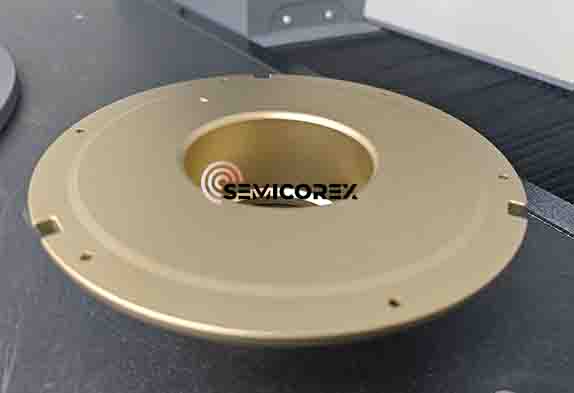
When a susceptor cycles from ambient to over a thousand degrees in minutes, the smallest thermal gradient becomes a stress concentrator. Uniform heating isn’t just about process consistency—it’s what prevents micro-cracks from propagating into outright fractures. Zones that lag even 15°C behind can bend the part enough to compromise wafer flatness, and with repeated excursions, that mechanical fatigue accumulates faster than most lifetime models predict.
What often gets overlooked is how coating delamination usually starts at thermal boundaries, not at the hottest point. A well-designed susceptor distributes energy so evenly that expansion and contraction happen in near-perfect synchrony across the entire surface. That synchronicity is the real metric: it’s what turns thousands of brutal ramp-ups into a predictable wear curve instead of a sudden failure.
Material choice plays a supporting role, but the geometry that manages heat flow is the star. Deep ribs, tapered edges, or asymmetric thinning in high-mass areas—these aren’t cosmetic. They’re engineered to force thermal lag out of the system, keeping the whole part in the same phase of expansion. In extreme cycles, that phase coherence is the difference between a reliable workhorse and a costly consumable.
Matching Coating Microstructure to Your Specific CVD Recipe Needs
Fine-tuning a CVD recipe isn't just about hitting a target thickness or deposition rate. It's about deliberately engineering the coating's microstructure to serve a precise function. Whether you need columnar grains for thermal barrier performance, a dense amorphous matrix for corrosion resistance, or a tailored multilayered architecture to manage stress, every process variable—from precursor flow and chamber pressure to substrate temperature and plasma power—leaves a distinct fingerprint on grain size, texture, porosity, and phase composition. Understanding these levers allows you to reverse-engineer your recipe so the microstructure becomes a predictable design feature rather than a trial-and-error outcome.
The real art lies in decoupling interdependent parameters. Raising the temperature might coarsen grains in one chemistry but trigger a phase transformation in another. Similarly, adjusting the precursor ratio can shift growth mode from isotropic to faceted, altering the way the film nucleates on complex geometries. By mapping out these relationships for your specific material system, you can prioritize the variables that most strongly influence the desired microstructural trait—be it fiber-textured columns for enhanced ionic conductivity or equiaxed nanocrystallites for improved hardness. Iterative recipe refinement then becomes a focused exercise in steering the film's inherent grain boundary network and defect population toward the performance envelope your application demands.
Ultimately, matching microstructure to recipe means treating the CVD chamber as a controlled synthesis environment, not just a coating deposition tool. In-situ diagnostics like optical emission spectroscopy or laser reflectance can provide real-time clues about nucleation and growth evolution, letting you fine-tune on the fly. When you couple this feedback with post-deposition analytics—fracture cross-sections, XRD, and TEM—you build a living process library that connects every knob turn to a tangible microstructural outcome. That's how you move from standard recipes to bespoke microstructures that are fully aligned with the thermal, mechanical, or electrical demands of your device.
Reading Between the Spec Sheets: Lifespan Data That Actually Matters
Most spec sheets treat product lifespan like a footnote—a single number buried between voltage ratings and warranty fine print, as if a blender lasting 400 cycles means the same thing in a family kitchen as it does in a smoothie bar. Real durability isn’t just about surviving a lab test; it’s about how a material creeps under daily load, how a seal responds to your city’s specific water chemistry, or whether that “50,000-hour” LED starts flickering like a haunted house after 6 months of your home’s power fluctuations. The numbers that actually matter are the ones manufacturers quietly test but rarely publish—the fatigue limit of a hinge after 100,000 micro-adjustments, the lumen depreciation curve when run 3°C above spec, or the salt-spray hours a switch survived before its first intermittent failure.
You spot the gap by looking for what’s not stated. A component labeled “10-year lifespan” without mentioning cycle count or environmental assumptions is a dressed-up guess. I’ve seen identical-sounding lithium cells with wildly different calendar lives because one had an additive package that suppressed electrolyte oxidation—something no product page ever brags about but that shows up in long-term coulombic efficiency data from third-party cycle testers. The trick is to chase after degradation curves, not celebrity endorsements. If a manufacturer won’t share an MTBF regression under load, or if their “lifetime seal” is tested only with distilled water, the numbers are polished fluff. Actual engineering truth lives in the marginalia: the bathtub curve shape, the coefficient of variance between batch samples, the shift in tenth-percentile failure time when relative humidity climbs from 50% to 80%.
Then there’s the mismatch between accelerated aging tests and your reality. A common scam is quoting lifespan from a 85°C/85% RH chamber and pretending it maps linearly to your living room—when in truth, certain polymers age exponentially faster above their glass transition temperature, and a 10°C office environment might give you ten times the life the spec implies. I treat any lifespan number stripped of its test standard like an unlabeled ingredient: dangerous until proven otherwise. What matters is whether the data was generated under a profile that echoes your usage, not a worst-case scenario designed to sell you on overdesign. The spec sheet’s real story is often in its omissions—ask for the raw reliability demonstration test data, the SEM photos of connector wear, the ultrasonic scan of internal cracks after shock cycling. That’s where the actual lifespan is hiding, between the rows of neatly rounded marketing figures.
Vendor Process Control Capabilities Beyond Basic ISO Certifications
Basic ISO certifications confirm a vendor has a documented quality management system, but they rarely reveal how deeply process control is embedded in daily operations. We look for vendors that treat process control as a living discipline—where real-time data from the production floor drives immediate adjustments, not just periodic audits. This means watching how they capture variation during a run, how they train operators to interpret control charts without overreacting, and whether their corrective actions address root causes rather than just symptoms. A certificate on the wall doesn’t tell you if a supplier can maintain tight tolerances when raw material batches shift or ambient conditions fluctuate.
True capability beyond ISO often shows up in the details of process capability indices such as Cpk and Ppk, but also in how a vendor uses those numbers. It’s not enough to see a Cpk above 1.33 on a quarterly report; we want to know the sampling strategy behind it, the timeline of when those samples were taken relative to tool changes or maintenance windows, and whether the vendor distinguishes between short-term capability and long-term sustained performance. Some suppliers bake a wide guard band into their measurements, artificially inflating capability numbers while masking drift that will eventually eat into your margins. The gap between a showcase capability study and what happens at 2 a.m. on a night shift is where value gets created or destroyed.
We also assess process control maturity by looking at how vendors manage interdependencies across multiple steps—thermal profiles, curing times, sequential machining tolerances—where a small shift upstream gets amplified downstream. A supplier that understands this will have feedback loops that don’t wait for final inspection; they use in-process checks at points of leverage to steer the outcome before nonconformance becomes scrap. Beyond any standard, we value the invisible infrastructure: the short interval control routines, the gage R&R studies that aren’t just annual formalities, and the shop floor culture that treats process stability as everyone’s responsibility rather than only the quality department’s.
When Partnership Beats Procurement: Technical Support That Saves Batches
We had a fermenter full of product that started drifting out of spec on a Friday evening — the kind of drift that turns a profitable batch into waste in a matter of hours. Most vendor relationships would have ended with a ticket and a promise to look at it Monday morning. Instead, our technical partner had an engineer dialed into the control system within fifteen minutes, walking our shift lead through a valve sequencing fix that kept the culture alive and on track.
That moment wasn't just about emergency response. It was the result of months of side-by-side troubleshooting on routine runs, where they’d taken the time to understand our specific strain behaviors rather than just quoting manual pages. When procurement purely chases the lowest unit cost, that depth of support vanishes, replaced by generic call centers and rigid escalation paths that don’t care about your timeline.
The real savings came later — not in spare part prices, but in the avoided disposal costs, the preserved downstream schedule, and the confidence to run tighter tolerances because we knew we had backup. Partnership means having someone who treats your process loss as their own problem to solve, not just a contractual obligation to fulfill.
FAQ
In high-temperature epitaxy, TaC stands out because it resists reaction with process gases like ammonia or silane far better than bare graphite or SiC coatings. It minimizes particle generation and metal contamination, which translates directly to better film purity and fewer device-killing defects. For processes pushing beyond 1600°C, uncoated graphite simply degrades too quickly, whereas TaC maintains surface integrity over hundreds of cycles.
You'll want to dig into how they deposit the TaC. Chemical vapor deposition (CVD) tends to give a denser, more conformal layer with superior adhesion compared to plasma spray methods. Ask about their precursor chemistry and process controls—things like gas flow uniformity and temperature gradients inside the reactor determine whether the coating will crack or spall after thermal cycling. A vendor that can provide cross-sectional SEM images and adhesion test data up front is usually the safer bet.
With TaC, it's not just about slapping on a thick layer. If the coating thickness varies by more than a few percent across the pocket area, you'll see temperature non-uniformity on the wafer, leading to variations in film thickness and composition. For high-performance RF or power devices, even a 2°C delta can shift the doping profile. A good vendor will specify both thickness tolerance and a direct correlation to on-wafer temperature measurements.
Beyond the usual ISO 9001, you'd want to see if they perform outgoing particle counts, surface roughness measurements by AFM, and full traceability of the graphite substrate grade. Some top-tier suppliers also offer lot-specific resistivity testing because the underlying graphite's bulk properties affect RF coupling in certain reactor designs. If a vendor can't tell you the average grain size or purity of their raw graphite, that's a warning sign.
If you're running a non-standard pocket geometry, have unique wafer warpage concerns, or need to integrate direct heating zones, customization becomes essential. The key is finding a vendor who doesn't just tweak CAD files but understands the thermal expansion mismatch between TaC and graphite, and can simulate how that stress redistributes during ramp-up. A proper custom design will factor in the exact radiant heating profile of your specific reactor model.
It's the foundation that everything else depends on. If the graphite has high porosity or anisotropic grain structure, outgassing during coating or subsequent high-temperature cycles can create bubbles or pinholes in the TaC layer. You want fine-grain, isostatically pressed graphite with low ash content—ideally below 5 ppm for critical processes. Reputable vendors will quote the exact graphite grade and its properties, not just call it 'high purity'.
Run a structured qualification: start with a thorough metrology check—SEM for coating morphology, EDS for stoichiometry, and a 3D profilometer scan of pocket depth and flatness. Then do a dummy wafer thermal mapping under full process gas flows, not just in an empty chamber. Finally, process your most defect-sensitive product and compare yield and particle maps. A supplier confident in their product will support such a qualification without hesitation.
Conclusion
Choosing a vendor for TaC coated susceptors goes far beyond checking a box on a procurement form. In epitaxial processes where even trace impurities can nucleate killer defects, the metallurgical purity of the coating becomes a make-or-break factor. You're not just buying a part—you're buying the cleanliness of the grain boundaries, the absence of free carbon clusters, and the vendor's deep understanding of how precursor gases interact with their specific surface chemistry. The best suppliers will walk you through how their coating's microstructure was developed to match a particular CVD recipe, whether that means optimizing for methyl radical adsorption or avoiding parasitic nucleation at the wafer edge. And when spec sheets tout lifespan, the real question is not just cycle count but the degradation mode: does the coating spall abruptly or wear gracefully with predictable emissivity shift? Vendors who openly share thermal imaging data from repeated thermal cycling reveal whether their susceptors can maintain that critical temperature uniformity across thousands of ramp-up and cool-down events, which is what truly saves you from scrapped batches caused by slip lines or thickness non-uniformity.
Yet the technical data only gets you so far. A vendor's on-paper process control certifications often miss the messy reality of production—what happens when a new coating operator interprets the spray parameters slightly differently, or when a batch of raw TaC powder shows a subtle shift in particle size distribution. Probe past the ISO certificate: ask how they track and flag these process drifts internally, and how quickly they can provide a corrective action report that traces a suspect batch back to specific spray booth conditions. Even more telling is when you treat the relationship as a partnership rather than a transaction. A supplier that invests time in understanding your reactor geometry, purge routines, and even your preventive maintenance schedule can offer technical support that prevents a disaster before it happens—like recognizing early signs of coating delamination from your post-run inspection data and adjusting your seasoning protocol. That level of collaboration rarely appears in a price quote, but it repeatedly proves to be the differentiator between a supplier that just ships parts and one that helps you ship product.
Contact Us
Contact Person: Svenja Wei
Email: [email protected]
Tel/WhatsApp: +8613567891907
Website: https://www.semicorex.com