

Stainless Steel Hex Self Drilling Screws Supplier Guide for Reliable Fastening Solutions
2026-11-02
Not all self-drilling screws are equal, and neither are the suppliers behind them. Stainless steel hex models that fail under torque or corrosion cost far more than their price tag. In this guide, we look at what to demand from a supplier—and how Wanluo delivers fastening solutions you can rely on from start to finish.
What Separates a Dependable Supplier From a Price-Only Vendor
A dependable supplier behaves less like a vendor and more like an extension of your own operation. They flag potential delays before they happen, keep you updated on production status without being asked, and remember the small details of your previous orders. A price-only vendor tends to vanish after the invoice is paid, leaving you to discover problems only when the shipment is late or the goods fall short of spec.
The gap becomes obvious the first time something goes sideways. A reliable supplier has backup plans for raw material shortages, is honest about current capacity, and will push back if your requested changes could compromise quality. The price-focused shop will quote an impossible number to win the job, then either cut corners on materials or hit you with surprise surcharges once you are too far along to switch.
Over a year of orders, the dependable supplier saves you from rework, missed deadlines, and awkward conversations with your own customers. Their paperwork is clean, their packaging is consistent, and their quality checks happen before shipping, not after your complaint. Price-only vendors leave a trail of small failures that add up to a much higher real cost.
Drill Point Geometry and Why It Dictates Your Installation Speed
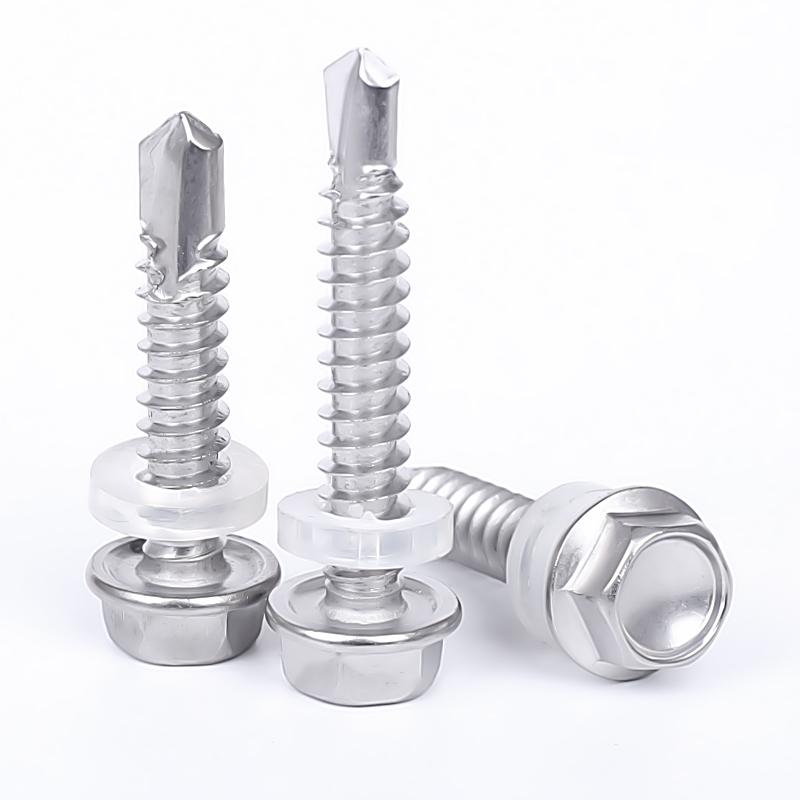
The point geometry controls how the cutting edges first engage the material, and that initial bite determines whether you're driving screws at a steady clip or fighting the tool every inch. A split point, for instance, drastically reduces the thrust needed to start the hole, which means less wandering, fewer broken bits, and a faster setup on hard metal. Meanwhile, a standard chisel point tends to skate until the web finds purchase, adding seconds per hole that stack up over a long run.
The included angle also plays a quiet but critical role. A 118-degree point is a generalist that handles mild steel and wood competently, but switch to stainless or hardened alloys and a 135-degree split point cuts noticeably cleaner with less resistance. That reduced resistance translates directly to higher RPM stability and lower heat buildup at the tip, so you can maintain feed pressure without pausing to clear chips or cool the bit.
What often gets overlooked is the relief angle behind the cutting edge. Too little relief and the tip rubs instead of cuts, generating friction that slows the drill and causes premature dulling. Too much relief and the edge becomes fragile, risking chipping when you hit a hard inclusion. Getting that balance right means the drill self-feeds smoothly, letting you keep a predictable rhythm instead of constantly backing out to clear debris.
Corrosion Resistance Beyond the Spec Sheet
Lab reports often tell a tidy story: a salt spray rating here, a coating thickness there. But real-world corrosion doesn't read the spec sheet. It starts in the places tests ignore—the backside of a weld, the crevice under a washer, the edge where a saw cut exposed raw metal. If your material choice stops at the data table, you're blind to half the failure modes.
Pay attention to how the product behaves after fabrication. Laser-cut edges, punched holes, and field-drilled fasteners can strip away protective layers faster than any salt fog chamber. Ask for corrosion data from cyclic exposure tests that alternate wet, dry, and UV—not just continuous spray. And look for evidence of how the coating survives thermal expansion, vibration, and abrasion, because those stresses often open the door for moisture long before the base metal gives up.
The real test is time in a specific microclimate. Coastal salt, industrial SO2, de-icing chemicals, or trapped condensation under insulation each attack materials differently. A product that excels in one setting can fail quickly in another. Before you commit, find installations similar to yours and ask what actually happened after five or ten years. That field record—not a polished spec line—is the strongest predictor of corrosion resistance you'll ever get.
How to Read Batch Test Reports Without a Metallurgy Degree
Batch test reports can look like a wall of incomprehensible numbers, but you don't need a metallurgy degree to pull out the essentials. Start by finding the material designation—usually a code like 304 or 6061—and check it against what your project actually ordered. Then scan the mechanical properties table. Tensile strength, yield strength, and elongation are your main trio; higher strength often means less ductility, so don't assume a higher number is always better. Look for any footnotes or flags near these values—a small 'NG' or an asterisk can signal a failed requirement, even if the average numbers seem fine.
Pay attention to the chemical composition section, but don't try to memorize every element. Focus on the few that matter most for your application: carbon in steels, magnesium and silicon in aluminum alloys, or sulfur and phosphorus as contamination indicators. If a value sits at the very edge of the specified range, treat it with suspicion—some suppliers round aggressively. A quick comparison against the standard's allowable limits is enough; no need to calculate phase diagrams. Also check the heat number and the date. A recent heat with consistent processing parameters matters more than a perfect-looking old report.
Finally, look for evidence of actual testing rather than just typed-in values. Legitimate reports include test method references, equipment IDs, or operator initials. If every number is oddly round or repeated across different heats, that's a warning sign. When something doesn't add up, ask the supplier for clarification instead of guessing. Reading a batch test report is less about decoding metallurgy and more about spotting inconsistencies—something any careful reader can do.
Thread Engagement Mistakes That Shorten Fastener Life
Most fastener fatigue starts at the threads, not the head. A bolt that only grabs a few turns in a tapped hole concentrates all the load on the first engaged thread. That single point becomes a stress riser, and once it yields, the next thread inherits the overload until the connection loosens or strips. The old rule of thumb about engagement equal to one diameter works for steel-on-steel, but softer parent materials like aluminum or cast iron need closer to two diameters of engagement to avoid pulling the internal threads out under tension.
Cross-threading during assembly is another quiet killer. When a screw starts slightly off-axis, the flanks of the male and female threads cut into each other instead of sliding together. The fastener may still tighten, but the contact area is reduced to a few sharp edges. Those edges deform under load, and the joint loses preload even though nothing visibly failed. Using a thread chaser or a proper starting technique—back-spin until you feel the lead drop—prevents most of this damage before it begins.
Finally, over-tightening with the wrong pitch or thread class wrecks engagement long before the wrench stops. A coarse-thread bolt forced into a fine-thread hole may feel snug, but only the tips of the threads are touching. The apparent torque is friction, not clamp load. That false torque reading lets the fastener back off in service or snap under a load it should have handled. Selecting the right thread designation and stopping at the specified torque, not the maximum the tool can deliver, keeps the engaged threads alive.
When to Request a Custom Coating Instead of Accepting Stock Options
Stock coatings often meet general needs, but there are clear signs it’s time to go custom. If your project involves unusual substrates, extreme temperatures, or aggressive chemical exposure, an off-the-shelf solution may degrade faster than expected. Custom formulations can be tuned to bond with specific materials, withstand thermal cycling, or resist solvents that would attack standard finishes.
Another trigger is when you need a precise combination of properties—say, low friction plus high dielectric strength, or optical clarity with abrasion resistance. Stock options usually force a trade-off, while a custom coating lets you prioritize multiple performance metrics in one layer.
Finally, if your production line has very specific application constraints—like a narrow curing window, a requirement for ultra-thin coverage, or compatibility with an existing wetting agent—a tailored coating can be designed around the process rather than forcing the process to adapt. This often reduces rework and long-term cost, even if the upfront price is higher.
FAQ
Ask about the specific grade. 304 works for general outdoor use, but 316 is the better bet anywhere salt spray or chemical exposure is a regular thing. Also check if the supplier passivates the screws and what kind of salt spray test results they can share.
A supplier that stands behind their product will typically offer mill certs or test reports without being asked, keep consistent thread dimensions across batches, and can tell you the actual hardness range of the drilling tip. If they hesitate on those details, keep looking.
They can be if the material is too thick or the screw speed is too high. A good supplier will give clear thickness limits for different diameters and recommend a lower driving speed for stainless, which work-hardens faster than carbon steel.
Most will offer standard machine threads for metal-to-metal connections and wider spaced threads for wood or composite decks. The best ones can also source fine threads or tri-lobular options if your project calls for them.
Ask for the grade marking on the head or packaging and request a material certificate. A simple magnet test isn't definitive because some stainless grades are slightly magnetic after cold forming, but a supplier that openly provides the heat number is usually trustworthy.
The drill point needs to be longer than the total material stack you're fastening. Suppliers typically categorize points by number, like #2, #3, #4, and #5, with higher numbers for thicker steel. A reliable supplier will help you match the point to your base material instead of selling you whichever is in stock.
Yes, galling is a common headache with stainless threads. Many suppliers apply a wax or anti-seize coating, and some offer screws with a slightly different thread profile to reduce friction. If your supplier doesn't mention galling, ask them directly—it shows whether they understand real-world installation.
Know your base material type and total thickness, the load or vibration the joint will see, and whether the screws will face outdoor exposure or chemicals. That lets a capable supplier recommend the right grade, point size, and thread instead of giving you a one-size-fits-all answer.
Conclusion
Choosing a stainless steel hex self-drilling screw supplier often comes down to more than just the lowest quote. A dependable partner will ask about your specific application, substrate thickness, and installation environment rather than simply pushing whatever is in stock. That matters because drill point geometry directly controls how fast the screw bites into the material. A poorly ground point can wander, overheat, or strip before the threads even engage, turning a quick job into a frustrating one. Similarly, corrosion resistance isn't just a number on a datasheet; it depends on how the stainless alloy behaves under cyclic temperature changes, chemical exposure, or salt spray. A good supplier will discuss those real-world conditions honestly instead of hiding behind generic claims.
Reading batch test reports doesn't require a metallurgy degree if you know what to ignore. Focus on tensile strength, hardness, and the presence of any surface contaminants rather than trying to decode every line. More importantly, avoid thread engagement mistakes—like using screws that are too short or forcing them into materials that haven't been properly pre-drilled when needed—because those errors quietly reduce clamping force and shorten fastener life. And when stock coatings won't survive your specific exposure, don't hesitate to request a custom option. A supplier worth keeping will treat that request as a normal conversation, not an inconvenience.
Contact Us
Contact Person: Shane
Email: [email protected]
Tel/WhatsApp: 8613357785029
Website: https://www.wanluohardware.com