

OEM Sidewall Cleated Conveyor Belt Benefits and Buying Considerations
2026-11-19
Replacing a cleated belt shouldn't feel like a gamble with incline angles, material type, and cleat profiles. Off-the-shelf options often fail where OEM sidewall cleated belts prove their worth—if you know which specifications to check. From base belt adhesion to corrugated sidewall flexibility, the right choices prevent spillage and early wear. YUFENG has seen how small design differences create big operational gaps. This guide breaks down the benefits and buying considerations that matter before your next purchase.
What Sidewall Cleats Change About Steep Incline Conveying
On a steep incline, the most immediate change sidewall cleats introduce is a shift from bulk material behaving as a continuous sliding mass to a series of smaller, supported pockets. Without cleats, material relies almost entirely on surface friction and internal shear, which fails quickly once the angle exceeds the material's natural repose limits. The cleats act as transverse barriers that interrupt downslope movement, letting the belt carry discrete volumes up grades that would otherwise require a pocket conveyor or a much longer, flatter route.
That pocketing effect also alters how the load settles during transfer. Instead of shifting and regrading after the loading point, the material is caught almost immediately against a cleat face, so the belt can accelerate or climb without waiting for the burden to stabilize. The trade-off is that fines and moisture tend to collect in the corners where each cleat meets the base belt, which changes cleanout requirements. Carryback on the return run is not just a thin film across the belt; it gathers behind the cleats and can drop off at idlers if the return side is not laid out with that buildup in mind.
Wear patterns shift as well. The leading faces of the cleats take most of the impact and shear load, especially where large lumps strike during loading and where the belt passes over transition rollers. This concentrates abrasion at the cleat tips and at the bond line, so service life becomes more about local tearing or debonding than about gradual cover wear. For steep climbs, drive calculations also need to account for the added flex resistance of the cleats around pulleys and the slight lifting action as each cleat pulls its pocket of material over the incline.
Choosing Cleat Height and Spacing for Materials That Slip or Shift
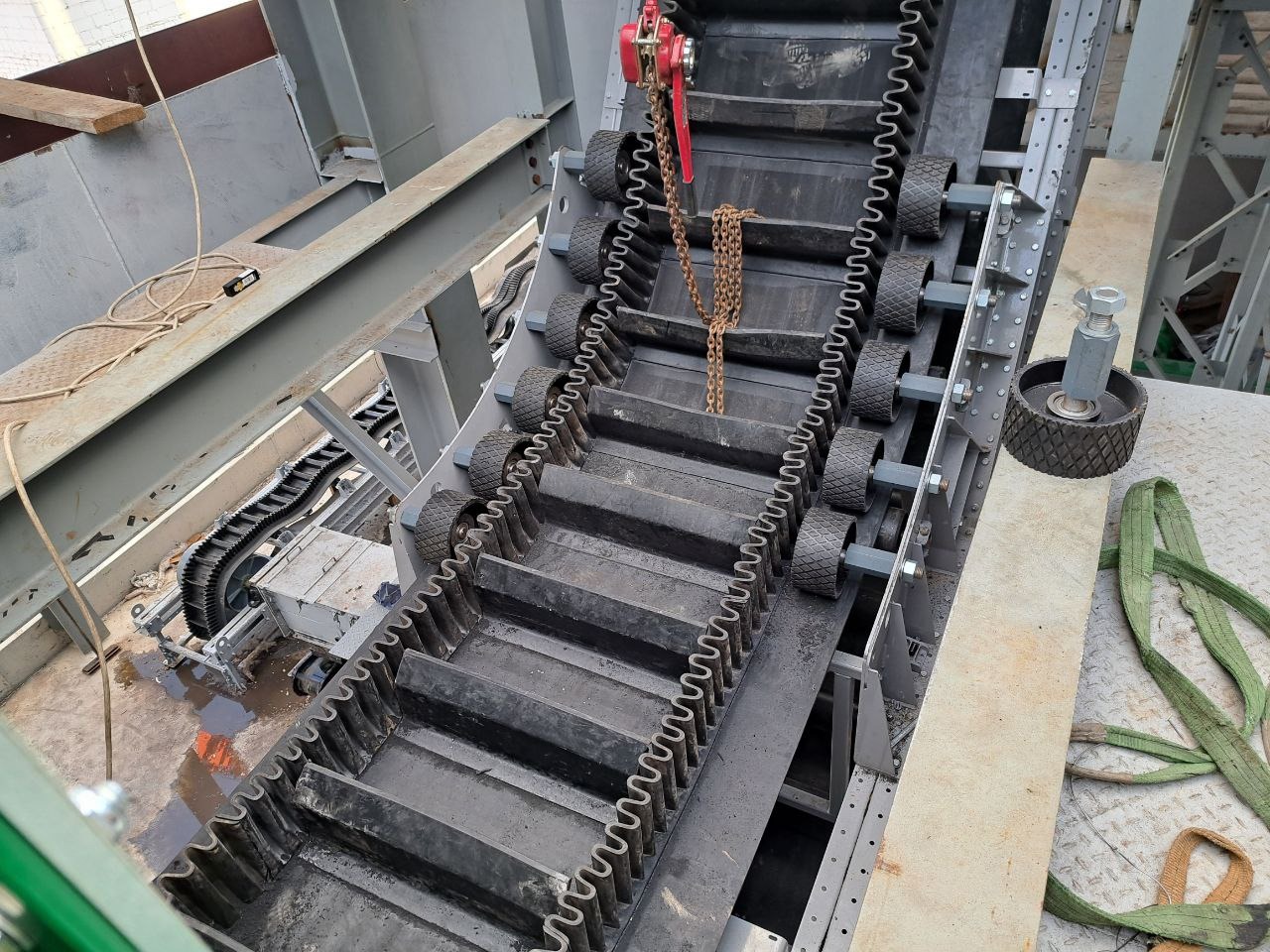
On a steep belt, rounded aggregate, wet bark, and oily metal scrap do not sit the way a standard cleat chart assumes. If the cleat is too low, the material rolls over the top and rides back down the incline. If it is too tall, the belt carries extra dead load and the cleats slap harder on return idlers. For materials that slip, start with a cleat height about one-third of the expected material bed depth, then move closer to one-half for slick fines or materials with very low internal friction. The cleat face has to create real containment, not just a small ridge.
Spacing is where most field adjustments happen. Wide spacing lets a slab of material break loose and slide backward as a unit, especially under uneven feeding or vibration. Tight spacing reduces carry volume and wears the cleat tops quickly. A useful starting point on steep inclines is twice the cleat height, then reduce spacing in small steps if the load shifts between cleats. For damp sand, wet clay, or hot plastic flake that tends to fluidize, start at one and a half times the cleat height. You will usually see the problem at the angle transition before it shows up further along the incline.
Confirm the choice with a short loaded test rather than trusting calculated values. Mark the cleat positions, watch the incline section during feeding, and check the return side for carryback. If sliding happens only where the belt changes from flat to inclined, raise the cleats in that section first. Slowing the belt by ten to fifteen percent can also stop shifting without a taller profile. These local adjustments often work better than replacing the entire cleat pattern, especially when moisture or feed size varies from shift to shift.
Why Cover Compound and Carcass Design Drive Belt Longevity
The cover compound does more than take surface wear. It controls how the belt absorbs impact, resists cuts and gouges, and handles heat or chemical exposure before the inner structure ever feels the load. A compound that is too hard may resist abrasion but crack under repeated flexing, while a softer cover may grip well yet wear away quickly. Matching the polymer blend and filler package to the actual material being carried often makes the difference between a belt that lasts years and one that starts failing at the edges early.
Carcass design determines how tension, troughability, and flex fatigue are spread across the belt. The number of fabric plies or steel cord layout, along with the adhesion between layers, affects whether stress concentrates at the splice, the center, or the edge. Poor layer bonding can quietly worsen long before visible cracking appears, especially where belts pass over smaller pulleys or carry uneven loads. When the cover and carcass are engineered to work together under the real operating tension and idler setup, the belt tends to outlast surrounding conveyor components.
Where OEM Belts Differ from Generic Replacement Options
The first place OEM belts set themselves apart is in the rib profile. A generic belt may be listed for the same length and number of ribs, but the angle at the bottom of each rib, the depth, and the spacing between ribs are not always identical to the original. Those small differences are enough to change how the belt sits in the pulley. Under load, a slightly shallow rib can climb instead of grip, which often shows up as a chirp on a damp morning or a polished shine on the pulley faces.
Materials and internal construction are another dividing line. Original belts are usually built around a specific cord package and rubber compound chosen for the heat range and tensioner movement of one engine family. Generic options tend to consolidate designs, so the cord spacing or rubber hardness may be close but not exact. That is why a replacement can measure fine on paper yet feel stiffer in the hand, and why it may start cracking earlier at the rib base after repeated heat cycles.
Fitment lists also create differences. OEM belts are developed for a particular accessory drive, including how the alternator pulley, idlers, and automatic tensioner behave together. A generic part is often grouped by dimensions alone, which means it can fit several vehicles but was not tuned for any one of them. The result is not always immediate failure, but subtle changes in belt tension, harmonic flutter, or idler bearing load that accumulate over time and shorten the service interval.
Load, Speed, and Tension Details to Confirm Before Buying
Before you settle on a model, check the load rating against the heaviest door or gate you actually plan to automate. Manufacturers often list peak capacity, but real-world performance drops once mounting points flex or duty cycles run long. Ask for the working load, not just the maximum stall force, and leave a margin if the panel is unusually wide or catches wind.
Speed matters more than the raw number on paper. A drive that opens quickly can feel convenient, but it may slam lighter panels or strain older hardware. Confirm whether the listed speed is measured under load or with no resistance, and find out if soft-start and soft-stop are built in rather than sold as add-ons.
Tension adjustments are where most installations get frustrating. You want a unit that lets you fine-tune travel limits and force sensitivity without opening the housing every time. If the spring or belt has fixed preset positions, make sure one of them actually matches your setup; otherwise you will be shimming, drilling, or fighting the unit on day one.
Installation and Tracking Practices That Prevent Early Belt Failure
Belt failures rarely start on the running face. Most come from what happens during installation: forcing a belt over a sheave with a pry bar, leaving sheave grooves worn or mismatched, or setting tension by feel and hoping. A cleaner install means pulling the motor base back far enough to slide the belt on without stressing the cords, checking sheave alignment with a straightedge or laser across both faces, and using a tension tester instead of thumb pressure. If the sheaves show visible grooving or the belts sit below the top edge, they need replacement before new belts are fitted.
Tracking adjustments after startup need to be small and measured. A belt that wanders to one side isn't always fixed by moving an idler; often the cause is a pulley not level, a splice that's thicker on one edge, or uneven material buildup on a return roller. Move the tracking roller in tiny increments, let the belt run for several minutes, and watch where it settles under load. Overcorrecting can chew an edge or stretch one side of the carcass, which shortens life faster than leaving it slightly off-center.
Document baseline conditions at installation and check them again after the first 40 hours. Record tension, tracking position, motor amp draw, and sheave temperature under normal load. If amp draw climbs or the belt develops a polished edge, something has shifted. Catching that shift early—before a belt flips, cracks, or takes out a bearing—is the whole aim. Frequent short inspections around startup and after any maintenance beat a detailed annual check that discovers damage months too late.
FAQ
Steep inclines become workable without extra transfer points. The corrugated sidewalls and cross cleats keep loose material from slipping back, so a single belt can often replace a multi-conveyor setup and reduce footprint.
It means the belt is built to the equipment maker's original profile and tolerances. You get a direct replacement rather than a generic belt that needs field trimming or creates tracking issues.
Free-flowing and semi-abrasive loads such as grain, crushed stone, sand, and small recycled aggregates are common. Sticky or highly abrasive materials can still work, but cleat style and rubber compound need more careful selection.
Belt width, incline angle, cleat height and spacing, sidewall height, pulley diameters, and the material's lump size and temperature. Missing any of these usually leads to delayed pricing or an incorrect belt.
Taller sidewalls and higher cleats carry more volume at steeper angles, but they also demand larger pulley diameters and can reduce flexibility. The goal is to match the profile to the incline and material characteristics rather than simply choose the largest size.
Premature edge wear, cleat cracking at the base, tracking drift, and material trapped between the sidewall and cleat are common clues. These usually point to the wrong compound, mismatched cleat spacing, or insufficient pulley diameter.
The upfront price can be slightly higher, yet the total cost is often lower because the belt fits correctly, tracks properly, and reaches its expected service life. Downtime and repeated adjustments tend to be more expensive than the initial saving.
Keep the return side clear of spillage, check sidewall and cleat bases for early cracks, verify tracking, and inspect pulley lagging. Small problems caught during routine checks usually prevent sidewall separation and sudden failures.
Conclusion
Sidewall cleated belts change the economics of steep incline conveying by letting a single belt replace multiple transfers or a bucket elevator in tight layouts. The cleats themselves do the real work: they hold material against the incline, reduce rollback on slippery or shifting products, and let the belt run at a steeper angle without sacrificing capacity. Matching cleat height and spacing to the actual burden matters more than many buyers expect. Too tall or too closely spaced, and fines pack between cleats, discharge suffers, and cleaning becomes a constant chore. Too low or too far apart, and larger lumps or rounded particles slide backward. The same logic applies to cover compound and carcass selection; a belt that survives abrasive stone may not handle oily grain or hot clinker, and the carcass must support both tension and cleat flex without separating at the bond line.
OEM belts usually differ from generic replacements in how the cleat profile, cover gauge, and carcass are matched to a specific machine's pulley diameters, take-up travel, and loading point. Before buying, confirm the actual load per hour, belt speed, and available take-up tension, because a generic belt with similar overall width may fail quickly if it cannot track properly or absorb the starting load. Installation and tracking practices are just as critical: a well-made belt mounted on misaligned idlers or with uneven splice tension will wander, rub sidewalls, and fail early. Spending time on pulley alignment, square splices, and proper break-in tension often extends service life more than paying extra for a premium belt.
Contact Us
Contact Person: Jayce
Email: [email protected]
Tel/WhatsApp: 8615318787602
Website: https://www.yuphengbelt.com/