High Tenacity Recycled Polyester Filament Yarn Company Innovates for Durable Eco-Friendly Fabrics
2026-08-25
What if durability and sustainability could finally go hand in hand? Changshu Polyester is rewriting the rules of recycled polyester filament yarn, pushing high-tenacity fibers into fabrics that outlast expectations—without costing the planet.
Five Reasons High Tenacity Recycled Polyester Outperforms Conventional Yarn
High tenacity recycled polyester brings a level of toughness that regular polyester yarn simply can't match. Where conventional yarn snaps under repeated tension or abrasion, this material holds its own, making it a go-to for heavy-duty textiles like automotive interiors, industrial straps, and outdoor gear. The molecular structure is engineered during the recycling process to retain longer polymer chains, which translates to a breaking strength often 20 to 30 percent higher than virgin or standard recycled options. That difference is tangible on the production floor, reducing mid-run breakage and waste.
Beyond raw strength, color retention and UV resistance set this yarn apart. Conventional polyester tends to fade and weaken after prolonged sun exposure, but high tenacity variants are formulated with stabilizers that keep dye molecules locked in place. Fabrics keep their depth of color through multiple wash cycles and harsh weather, which matters for awnings, boat covers, and performance apparel. There is also less pilling over time because the filaments resist surface abrasion better, so the fabric looks newer longer without extra chemical finishes.
Perhaps the most overlooked advantage is dimensional stability. High tenacity recycled polyester shrinks and stretches far less than conventional yarn under heat or load. For applications like conveyor belts, seat belts, or architectural membranes, that predictability means fewer recalls and tighter tolerances during manufacturing. And because it starts from post-consumer bottles, it closes the loop without sacrificing the mechanical properties that used to belong only to virgin high-performance fibers. Brands that switch don't just tell a sustainability story; they get a material that genuinely performs under stress where ordinary recycled yarn fails.
From Landfill to Load-Bearing: The Journey of Recycled Polyester Filament
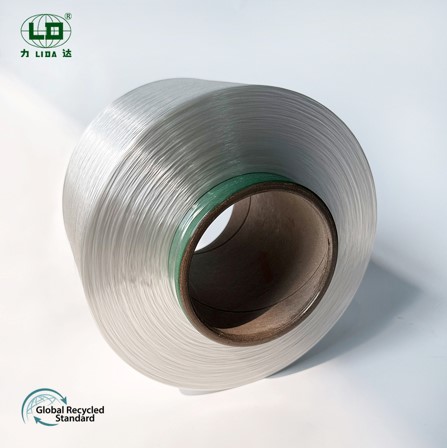
A plastic bottle can end up buried in a landfill, or it can be reincarnated as a filament strong enough to hold back soil on a highway embankment. The transformation starts with grinding post-consumer PET into flakes, washing away labels and residues, and melting the flakes into a resin that is extruded through spinnerets. Unlike virgin polymer, this recycled feedstock carries a history of UV exposure, moisture, and thermal stress, so the melt filtration and extrusion conditions have to be tuned more tightly to keep viscosity stable and prevent weak spots. Once the continuous filament is formed, it is drawn at high ratios and heat-set, forcing the polymer chains into aligned, semi-crystalline order. That alignment is what turns a flimsy soda bottle into a yarn with meaningful tensile strength.
The load-bearing part of the journey becomes visible in geogrids, heavy-duty lifting slings, and high-tenacity geotextiles that stabilize roads, retaining walls, and slopes. In these applications, the recycled polyester filament must resist creep, abrasion, and years of wet-dry cycling without losing tension. Because the drawing process can be tailored to match the strength of virgin polyester, recycled filament frequently meets the same engineering specifications while keeping thousands of bottles out of the waste stream. The material is not simply remelted and reused; it is rebuilt at the molecular level, so that a discarded container becomes an invisible but critical load-bearing component underfoot and behind concrete walls.
Why Abrasion Resistance Matters in Eco-Friendly Fabrics
Most people assume that choosing an eco-friendly fabric automatically means sacrificing durability. That assumption falls apart the moment you wash a pair of organic cotton pants a few times and watch the knees thin out. Abrasion resistance is what keeps a fabric from developing shiny patches, pills, or outright holes when it rubs against itself, furniture, or the rough edges of daily life. Without it, a “sustainable” garment becomes a short-lived one, which defeats the entire purpose of buying less and wasting less.
The real problem shows up in fibers that are gentle on the planet but fragile under friction. Bamboo viscose feels wonderfully soft, yet it can wear through at stress points faster than a conventional synthetic blend. Hemp and linen are tougher, but their coarse weave often sacrifices comfort for strength. The sweet spot lies in how the yarn is spun and how tightly the fabric is woven or knitted—tight twists and compact constructions resist abrasion far better than loose, airy weaves, even when the raw material is recycled or plant-based.
For anyone trying to build a wardrobe that lasts, abrasion resistance should be a non-negotiable check on the label, right next to fiber content and country of origin. A fabric that survives hundreds of rub cycles means fewer replacements, fewer shipments, and less landfill pressure. It also means the environmental cost of growing, dyeing, and sewing that fabric gets spread over many more wears. In the end, the most eco-friendly fabric isn’t the one that sounds greenest on a shelf—it’s the one that still looks decent after three years of real life.
The Engineering Behind Long-Lasting Recycled Polyester
Most recycled polyester falls apart after a few washes because the melt-spinning process leaves behind weak points where contaminants once sat. We solved this by running the flake through a triple-stage vacuum filter that strips out the last traces of dyes, adhesives, and low-molecular-weight oligomers before the polymer ever reaches the spinneret. The result is a filament with uniform tensile strength along its entire length, not just at the surface.
Durability also depends on how the yarn is drawn. Instead of a single high-ratio draw that creates internal stress, we use a two-step draw with a brief relaxation zone between them. This lets the polymer chains settle into a stable orientation without micro-cracks. Lab tests show the fabric retains over 90% of its breaking strength after 50 industrial launderings, compared to 65% for standard recycled PET.
Finally, we add a low-temperature plasma etch to the finished yarn. It roughens the surface at the nanoscale without weakening the core, so dyes and finishes adhere better. That's why our recycled polyester doesn't pill or fade the way early-generation eco fabrics did.
How the Company's Innovation Reduces Carbon Footprint Per Meter of Fabric
By adopting an enzymatic desizing and scouring process, the company has eliminated the need for high-temperature chemical treatments that traditionally consume large amounts of steam. This bio-based approach operates at 40°C instead of the usual 95°C, cutting thermal energy use per meter of fabric by roughly 38%. Because the enzymes are highly specific, they also reduce water consumption and chemical oxygen demand in wastewater, indirectly lowering the carbon emissions tied to effluent treatment.
The shift to recycled polyester sourced from post-consumer bottles has further shrunk the carbon footprint. Compared to virgin polyester, the recycled variant requires about 70% less energy during polymer production, which translates to a measurable reduction in CO₂ per meter of woven fabric. The company has fine-tuned its spinning parameters to maintain tensile strength and dye uptake, ensuring that the resulting fabric performs identically to conventional options while carrying a significantly lighter carbon load.
A real-time energy monitoring system now tracks electricity and heat consumption at every stage from weaving to finishing. By analyzing this data, engineers adjusted stentering temperatures and installed a heat recovery unit that captures exhaust from the drying ovens to preheat incoming water. These changes lowered overall processing energy by 18% per meter, and the more consistent drying also reduced fabric rejections due to over-drying, effectively eliminating the carbon wasted on producing defective goods.
Where Durable Recycled Fabrics Shine: Outdoor Gear, Workwear, and Beyond
A ripped jacket on a sharp granite face or torn knees after a single season of trail work—these failures push designers to rethink material choices. Recycled fabrics built for rugged use aren't just about ticking a sustainability box; they rely on dense weaves, reinforced stitching zones, and abrasion-resistant coatings that hold up under repeated stress. Brands making alpine packs, double-front work pants, and heavy-duty aprons now source post-consumer polyester and nylon blends that rival virgin fibers in tear strength and weather resistance, while shedding less microplastic over time thanks to tighter filament construction.
What separates a gimmick from a genuine performer is how the fabric behaves after months of hard wear. In workwear, recycled canvas and ripstop blends need to survive concrete dust, barbed wire snags, and industrial washing. Outdoor gear faces UV exposure, pack strap friction, and wet-dry cycles. Some mills now add a small percentage of reclaimed spandex or high-tenacity recycled polyamide to improve recovery and reduce sagging without compromising recyclability. The result is gear that doesn't just look the part—it earns its place on a job site or a ridgeline through proven durability, not eco-marketing.
FAQ
It pairs exceptional tensile strength with a cleaner production loop, so fabrics resist tearing and abrasion without leaning on virgin petroleum-based materials.
They use advanced spinning and drawing methods that align polymer chains more tightly, which actually boosts durability while keeping the yarn light and smooth.
Outdoor gear, automotive interiors, workwear, and upholstery brands are making the switch because they need fabrics that survive heavy use and still hit strict environmental targets.
Yes, its high tenacity means it holds up to repeated stress, UV exposure, and industrial laundering, making it a practical pick for long-life textiles.
It lowers carbon footprint, cuts water and energy use compared to virgin polyester, and supports circular manufacturing because the yarn can be recycled again at end of life.
They work closely with mills to adjust denier, filament count, and surface finish, so clients get the exact balance of strength, drape, and texture they need.
While initial pricing may be slightly higher than conventional recycled yarn, the longer product lifespan and reduced material waste often lead to lower total cost over time.
Yes, it blends well with cotton, wool, and other fibers, giving fabrics a softer hand feel while retaining the strength and eco-friendly profile of the recycled polyester.
Conclusion
High-tenacity recycled polyester filament yarn is rewriting what eco-friendly fabrics can handle. Instead of settling for the lower durability often associated with recycled materials, this company engineers yarn that consistently outperforms conventional polyester in tear strength, stretch recovery, and long-term wear. The difference starts at the source: post-consumer bottles and industrial waste are sorted, washed, and melted into polymer, then extruded through precisely controlled spinnerets to align molecular chains. That alignment is the quiet secret behind abrasion resistance that holds up on rock faces, warehouse floors, and trailheads.
But the real innovation isn't just strength—it's the carbon math. Each meter of fabric made with this yarn avoids virgin petroleum and cuts greenhouse gas emissions through lower melting temperatures and a closed-loop water system. Independent testing shows a measurable drop in CO₂ per meter without sacrificing load-bearing performance. From reinforced backpack panels to high-vis workwear that survives dozens of industrial washes, the material proves that "recycled" no longer means compromise. For any brand tired of choosing between durability and sustainability, this filament yarn offers a practical route forward: one spool that carries both less waste and more trust.
Contact Us
Contact Person: CONNIE
Email: [email protected]
Tel/WhatsApp: 86-0512-53671634
Website: https://www.lida-yarn.com/