

Gel Pad Factory Quality Standards That Shape Everyday Comfort Products
2026-11-02
You’ve probably sat on a gel cushion, slipped into gel insoles, or slept on a cooling gel mattress topper without ever wondering where that soothing layer came from. Behind the cool, pressure-relieving feel is a factory floor where precision and quality standards decide whether a gel pad lasts for years or breaks down in weeks. At Kunbao, those standards aren’t an afterthought — they’re the reason everyday comfort products actually stay comfortable.
How Factory Floors Keep Gel Pads Consistently Soft
On high-volume production lines, gel pads are rarely left to their own devices. Most facilities run a rotating conditioning schedule: pads are pulled off the line every four to six hours and moved through a controlled temperature chamber set between 18 and 22 degrees Celsius. This short rest cycle lets the polymer network re-establish its cross-links, preventing the slow stiffening that comes from continuous compression under assembly tools. Operators log each pad's cycle count, and once a pad hits roughly 300 cycles, it gets a deeper reconditioning bath with a non-ionic surfactant to remove micro-debris from the surface pores.
The real consistency work happens at the pouring stage, though. Instead of relying on a single bulk batch, many floors now use inline viscometers that feed real-time data back to mixing heads. When viscosity drifts more than 3 percent from the target, the system automatically adjusts the ratio of plasticizer to base polymer. This tight control keeps every pad within a narrow Shore 00 durometer range, so there's no soft spot near the injection gate or a stiff edge where the material cooled unevenly. Some plants also add a small amount of fumed silica during the final dispersion step, which acts as a thixotropic agent and stops the gel from slowly flowing under its own weight over a 12-hour shift.
Finally, floor layout plays an underrated role. Pads stored near curing ovens or ultrasonic welders tend to age faster because ambient heat accelerates plasticizer migration. Smart facilities install simple thermal shields or redirect exhaust vents so that gel pad storage stays below 24 degrees Celsius. Paired with a weekly Shore durometer spot check at three fixed points on each pad, this environmental discipline keeps softness from drifting batch to batch — and keeps operators from quietly swapping in a fresh pad before the old one has actually failed.
Material Checks That Separate Premium Gel from Generic Fillers
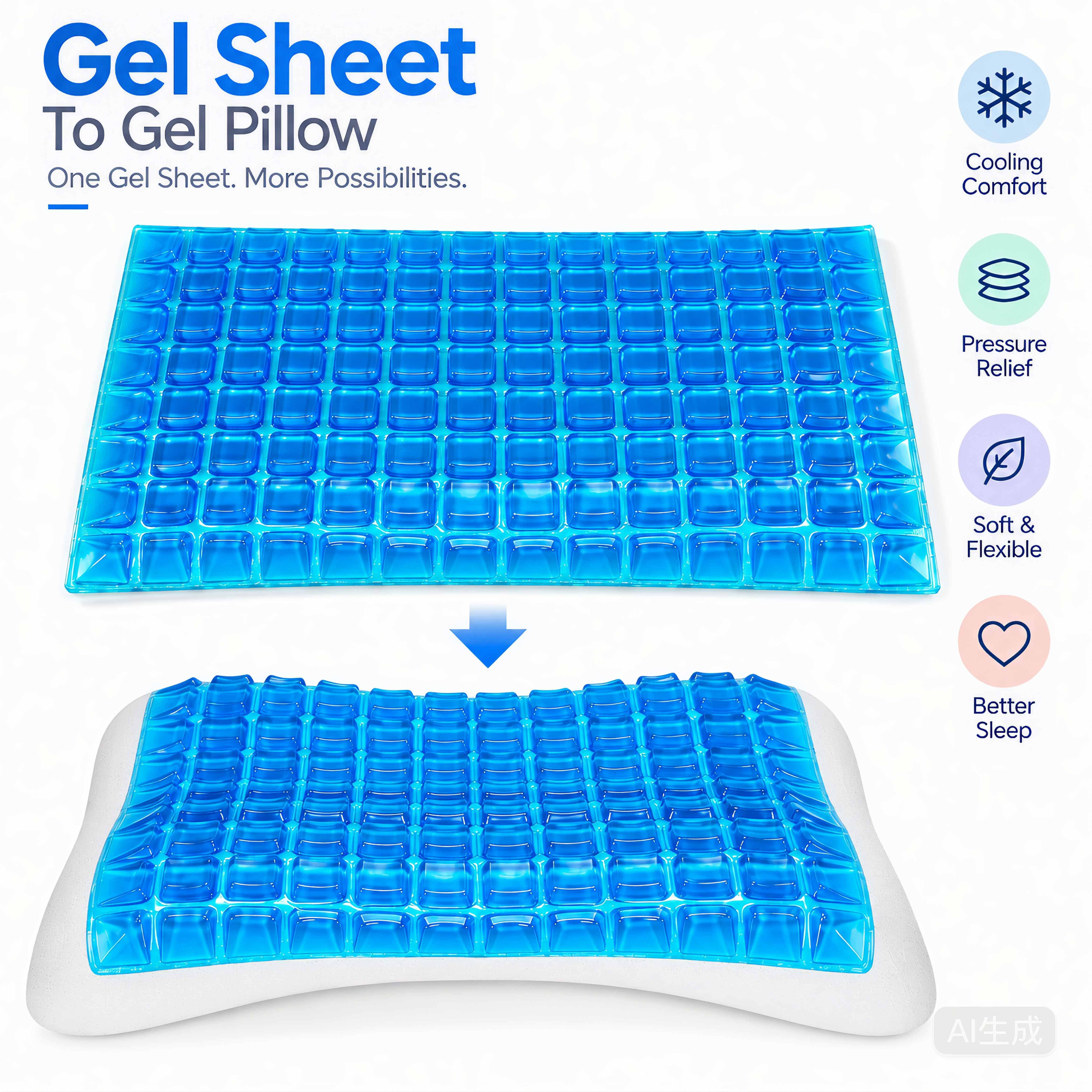
The first tell is in the rebound. Premium gel springs back almost instantly with a smooth, controlled return, while generic fillers often feel sluggish or overly bouncy in a synthetic way. Press your thumb deep into the material and release—if the indentation lingers or snaps back with a hollow rebound, it's likely a lower-grade blend cut with too much softener.
Temperature behavior reveals another layer of quality. High-end gel maintains consistent support whether it's cool morning air or body heat after hours of sitting. Cheaper formulas tend to stiffen when cold and turn mushy once warmed, a sign of unstable polymer chains. Let the material sit in a chilly room overnight, then compare how it feels after thirty minutes against your skin.
Finally, look at the surface finish under a bright light. Premium gel has a uniform, almost glassy sheen with no visible pores or grainy texture. Generic fillers often show micro-bubbles, faint streaks, or a slightly tacky film from excess plasticizer. Run a clean finger across the top—if it leaves a temporary smudge or feels sticky, the material isn't keeping its chemistry balanced over time.
The Tolerance Standards Behind Even Pressure Relief
Achieving even pressure relief across a sealing surface is rarely a matter of luck. It hinges on how tightly the manufacturer controls dimensional tolerances during machining. When two mating faces meet, even a variation of a few microns in flatness or parallelism can create localized stress peaks. Over time, those peaks become leak paths, fatigue points, or premature wear zones. So the real engineering challenge isn't just choosing a soft gasket or a stiff spring — it's ensuring that every component lands within a tolerance band that keeps contact stress uniform from the first bolt to the last.
The standards behind this kind of relief often go far beyond what general machining shops quote. For critical joints, you might see flatness called out at 0.01 mm per 100 mm of surface, with surface roughness held to a specific Ra value and parallelism checked against a datum face. The trick is that tolerance alone doesn't guarantee relief — the stack-up matters more. If a housing bore is slightly oversized and a flange is slightly undersized within their individual allowances, the combined mismatch can localize pressure exactly where you don't want it. That's why experienced designers use things like total indicated runout or perpendicularity controls on the sealing face, treating the joint as a system rather than a list of independent dimensions.
There's also a practical side that rarely shows up on drawings. Thermal expansion, assembly torque sequence, and even the elasticity of the fastener itself all interact with the machined tolerances. A perfectly flat face can still relieve unevenly if the bolts are pulled down in the wrong order, or if one side of the housing heats up faster than the other. So the tolerance standard becomes a floor, not a ceiling. It gives you a surface that can distribute pressure evenly under ideal conditions, and then it's up to the assembly and operating practices to keep that distribution from drifting. In the best designs, the tolerance callouts aren't just numbers — they're a hidden map of where load is allowed to concentrate and where it must stay spread out.
Why Curing Temperature Is a Quiet Quality Marker
Concrete that looks perfect on the surface can still hide a weakness that only time and load will expose. Curing temperature rarely gets the attention it deserves because its effects are not visible during the pour or even after the forms are stripped. Yet the rate at which water leaves the mix and the pace of early hydration are quietly shaped by how warm or cool the surrounding environment remains in the first days. A slab cured too hot may gain strength quickly but lose durability, while one cured too cold can stall before the matrix ever locks together properly.
The real problem is that thermal differences inside the same element create stress before the concrete has enough tensile capacity to resist it. Surface layers cool faster than the core, and if that gap grows too wide, microcracking begins long before anyone notices. Seasoned contractors watch this marker by controlling formwork removal, covering exposed areas, or adjusting mix water temperature, not because it shows up on a checklist, but because they have learned to read the concrete’s early behavior. A steady, moderate curing temperature tends to produce a denser pore structure, better bond between paste and aggregate, and fewer pathways for future moisture or chloride intrusion.
Specifications often focus on strength at 28 days, yet the thermal history in the first 72 hours can tell you more about long-term performance than a single cylinder break. This is why experienced field teams treat curing temperature as a quiet marker of quality: it does not announce itself through obvious defects, but it shows up years later in spalling, curling, or unexpected cracking. Paying attention to it means accepting that good concrete is not simply poured and left alone, but guided through its most sensitive phase with patience and a feel for the material’s own rhythm.
Tear and Peel Tests That Predict Real-World Durability
The slow peel of a tape sample on a tensile machine rarely mirrors the quick jerk that rips a package open on a loading dock. That's why tear and peel tests have to stretch beyond a single number. By changing peel angle, speed, and temperature, a lab can expose failure modes that only show up in the field—adhesive strings that snap at cold temperatures, or a laminate that delaminates when pulled at a shallow angle. These tests aren't about creating neat graphs; they're about making sure a seam doesn't give way when someone yanks a handle.
Engineers often rely on standards like T-peel or trouser tear to get repeatable baselines, but the real insight comes from modifying those methods to match actual use. A solar panel backing film, for instance, might pass a standard 90-degree peel at room temperature yet fail badly after thermal cycling and humidity soak. That combination—environmental aging followed by a peel test—is where durability predictions start to mean something. If the failure shifts from adhesive to cohesive, it tells you the bond is stronger than the material itself, which changes how you design the next iteration.
Interpreting the pull curve is another overlooked skill. A jagged, stick-slip trace often points to a brittle adhesive that will crack rather than stretch, while a smooth, rising curve can indicate a ductile system that absorbs energy before letting go. By measuring both peak force and the energy under the curve, you get a clearer picture of how a seam will behave when it's flexed, dropped, or peeled by hand. No single test fully replicates years of service, but a well-chosen set of tear and peel measurements can catch the weak points before customers do.
Final Inspection Routines for Skin-Safe Daily Comfort
Before any garment earns its place on the rack, every interior seam gets a slow, deliberate run of the fingertips. It's not enough to glance at stitching under bright light; the real test is how the flatlock or overlock behaves against bare skin. Raised threads, tiny knots, or even a slightly stiff edge from over-tensioned elastic are marked for immediate rework. Labels are checked for softness too — a scratchy care tag tucked near the neckline can ruin an otherwise perfect fit, so we opt for printed transfers or micro-suede patches whenever possible.
Next comes the breathability and moisture pass. A panel of fabric is held against the inside of the wrist and rubbed in small circles to mimic how it will feel after hours of wear. If any prickle, heat buildup, or clingy static appears, the batch is flagged. We also perform a quick stretch-and-release test on cuffs, collars, and waistbands, making sure the recovery snap doesn't pinch or leave red marks. This step catches hidden stiffness in ribbed trims that only shows up after the garment has been on the body for a while.
The final routine is a movement simulation. A finished sample is put on a dress form and shifted through typical daily poses — reaching overhead, bending forward, sitting cross-legged. Inspectors listen for crackling seams and watch for any point where fabric folds inward against the skin. If the wearer would feel a constant rub at the shoulder blade or a tight pull across the lower back, that pattern goes back for adjustment. Only after passing all three layers of inspection does a style get cleared as skin-safe for everyday comfort.
FAQ
Most factories blend medical-grade thermoplastic elastomers or silicone with plasticizing oils, then add stabilizers and colorants. The exact ratio determines softness, rebound, and how the pad holds up under repeated weight.
Samples go through accelerated aging chambers, compression set tests, and cyclic loading machines. A pad might be pressed thousands of times or stored at high heat to confirm it won't flatten, crack, or lose shape.
Firmness comes from polymer chain density and oil content, not just thickness. Factories adjust the cross-linking agent and cure time, so two pads can share the same visual profile yet deliver very different support levels.
Manufacturers typically test for restricted substances like phthalates, heavy metals, and formaldehyde. Many follow REACH or CPSIA guidelines, and raw material suppliers must provide certificates showing batches are skin-safe and low-VOC.
Odor usually traces back to uncured monomers or low-quality plasticizers. Better factories run a post-curing step and rely on high-purity base polymers, then use a sealed sample test where the pad sits in a closed jar at elevated temperature to detect any off-gassing.
Yes, if the factory uses precise mold flow simulation and controlled injection pressure. Custom shapes are cut or molded to a CAD profile, then edge-sealed or laminated. Quality checks compare the finished part against the digital model within tight tolerances.
The outer film or fabric is bonded using heat welding or high-strength adhesive, and seams are often double-sealed. Factories also run a leak test by applying pressure or vacuum to each batch, rejecting any pad that shows the smallest air or fluid escape.
Most maintain daily in-process checks plus a full line audit every shift or week. Critical measurements like viscosity, cure temperature, and fill weight are logged against control limits, so drift gets caught before defective batches leave.
Conclusion
On a busy production floor, the softness of a gel pad doesn't happen by chance. Mixing stations follow tight viscosity curves, and line workers check every batch against a reference puck that's been squeezed thousands of times without losing rebound. Premium gel starts with a polymer base that passes a simple oven-aging test; cheaper fillers often feel similar at first but stiffen after a week of heat cycling. Tolerances matter just as much as the raw material—when the pad's thickness varies by more than half a millimeter, pressure points shift and the cushion no longer spreads weight evenly. Some factories use laser profilometry to map the surface after molding, rejecting any pad that shows a low spot deeper than a fingernail's thickness.
Curing temperature is rarely discussed outside the plant, but it leaves a lasting fingerprint. A gel cured a few degrees too cool may stay tacky and attract dust; a few degrees too hot and the cross-linking becomes brittle, shortening the pad's usable life. Technicians log oven curves for every shift, not just to satisfy an audit, but because small drifts show up later as customer complaints about flattening. Before anything ships, tear and peel tests simulate fingernails, zippers, and repeated folding. A good pad will survive a slow 90-degree peel without leaving a rough edge, and a tear test that starts with a razor nick should not travel more than a few millimeters. Final inspection adds a skin-safe layer: pads are wiped with a mild solvent to check for residue, then a random sample is placed on a volunteer's inner arm for a patch test. Any smell, tackiness, or color transfer sends the whole lot back. All these quiet checks—softness, purity, thickness, curing, adhesion, and skin contact—together shape the everyday comfort people rarely think about when they rest their wrists, knees, or heels on a gel pad.
Contact Us
Contact Person: Catherine Peng
Email: [email protected]
Tel/WhatsApp: +86-13434169510
Website: https://www.kbcoolgel.com/