

Electric Wheelchair for the Elderly OEM Manufacturing Partner Selection Guide
2026-08-14
Choosing an OEM partner for elderly electric wheelchairs feels like navigating a minefield of glossy brochures and unspoken compromises. The wrong decision doesn't just cost money—it can put vulnerable users at risk. In this guide, we skip the sales pitch and dig into what actually matters: frame integrity, battery safety, component traceability, and whether a factory truly understands geriatric mobility needs rather than just copying specs. You'll also see how Freedomchair approaches these challenges in its own manufacturing partnerships, so you can benchmark your selection criteria against real-world practice. If you've ever wondered why two wheelchairs with identical datasheets perform so differently in the field, this guide will give you the answers.
Separating Genuine Elderly-Centric Engineering from Standard Powerchair Claims
Many powerchair brochures toss around phrases like “senior-friendly” without ever explaining what that means beyond a padded seat and a joystick. Genuine elderly-centric engineering starts with the assumption that the user’s hands, eyesight, and reaction times are not those of a forty-year-old. That translates into controls that require less than 200 grams of force to activate, buttons with tactile ridges you can find by feel while wearing arthritic gloves, and displays that prioritize contrast over sleek minimalism. If a chair still demands precise finger dexterity to adjust speed profiles or navigate a touchscreen menu, it is not designed for an aging body—it is simply a standard chair with a gray paint job.
The second tell comes from how the chair handles real-world indoor spaces rather than showroom floors. A true elderly-focused design accounts for narrow bathroom doorways, thick carpeting, and the need to pivot within a galley kitchen without clipping cabinets. That means anti-tip wheels positioned to allow a tight turning radius, not just bolted on for compliance. It means seat heights that let a user plant both feet flat on the ground before standing, and armrests that swing away with one hand instead of requiring a two-step release. Standard powerchair claims often highlight top speed or range, but for an older user, the ability to back out of a bedroom without scraping the doorframe matters far more than traveling an extra five miles.
Finally, genuine elderly-centric engineering extends beyond the chair itself to the service and parts network. A seventy-five-year-old user should not need to schedule a technician visit just to replace a cracked joystick boot or adjust a footplate. Modular components with tool-free release mechanisms, wiring harnesses that use color-coded connectors large enough to see without magnification, and batteries that slide out from the side rather than requiring the user to kneel and lift from below—these are the quiet signals of thoughtful design. When a manufacturer brags about “advanced suspension” but ships the chair with a manual that assumes you have a smartphone app to troubleshoot errors, the claim falls apart. Older users deserve engineering that respects their time, their joints, and their independence, not a list of features that only impress a spec sheet.
Where Battery Longevity and Motor Torque Meet Real-World Senior Mobility
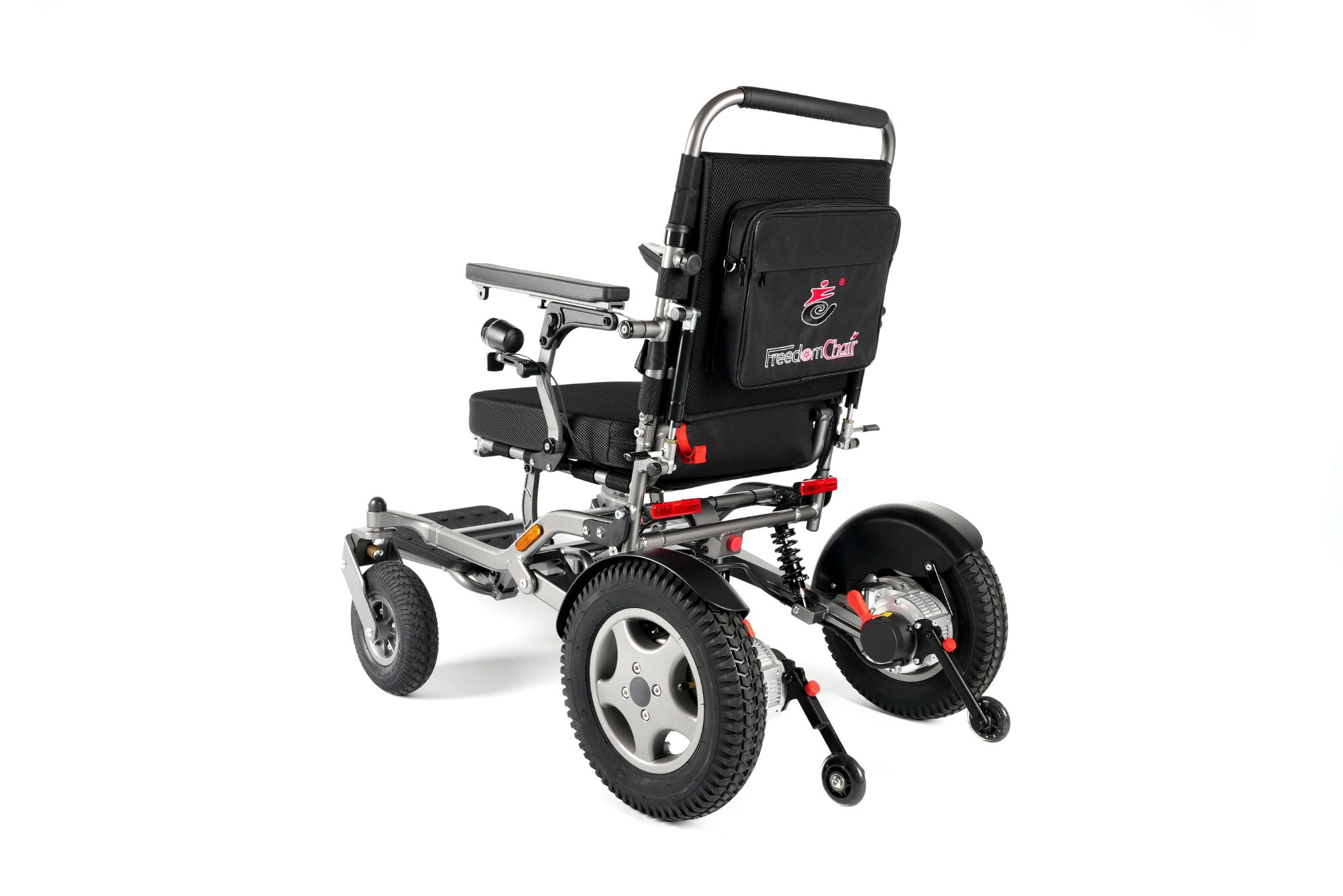
Real senior mobility isn't about raw horsepower or flashy acceleration—it's about whether the chair can handle a slight curb cut without stalling, and whether the motor's torque delivery stays smooth when crawling through a narrow doorway. Many manufacturers chase peak wattage numbers that look impressive on paper, but on a carpeted hallway or a gravel path, that peak is rarely reached. What matters more is how the controller modulates current at low RPMs, because that's where everyday life happens: inching forward at a dining table, pivoting near a bed, or holding steady on a ramp while the user shifts weight. A well-tuned motor and battery pairing keeps those micro-adjustments effortless, so the user never feels the system fighting back or lurching unexpectedly.
Battery longevity plays a quiet but decisive role in that real-world feel. A pack that sags under load won't just reduce range on the spec sheet—it'll cause the motor to lose composure exactly when the user needs confident low-speed control, like crossing a threshold or turning on an incline. The best setups use cells with a flat discharge curve and pair them with a controller that draws current predictably, avoiding sudden spikes that degrade both the cells and the riding experience. Over months of daily use, that translates into a chair that still holds its line on a sidewalk crack after hundreds of charge cycles, instead of one that gradually feels weaker and twitchier. For a senior user, that consistency is a form of safety.
The sweet spot, then, is where motor torque and battery management are designed as a single system rather than bolted together from off-the-shelf parts. A modest motor with excellent low-end control and a battery that delivers steady voltage under partial load will often outperform a high-torque motor paired with a stressed, aging pack. That's why test rides matter more than datasheets: a chair that feels composed at walking speed, silent on a thick rug, and predictable when reversing out of an elevator is the one that truly serves a senior's daily mobility—not the one with the boldest claimed torque or the longest theoretical range.
Digging Into Frame Integrity, Foldability, and Daily Wear Resistance
The frame doesn't just look sturdy on a spec sheet—it's been put through repeated torsion and impact tests to see where stress builds up around the hinge and down tube. Instead of relying on a single oversized weld, the design distributes load across a reinforced pivot block and double-butted tubing, which keeps the ride feel tight even after months of folding and unfolding.
Foldability here isn't an afterthought. The latch mechanism uses a sprung steel pin that seats into a machined receiver rather than a simple friction clamp, so you get the same alignment every time without having to fiddle with barrel adjusters. Daily wear resistance comes from small choices: stainless hardware at high-contact points, a powder coat that shrugs off keys and shoe scuffs, and replaceable hinge bushings that take the abuse instead of the frame itself.
Checking Whether a Factory’s Quality Culture Matches Regulatory Demands
A genuine quality culture isn’t measured by slogans or framed posters, but by how staff react when no auditor is watching. Walk the production floor at shift change and observe whether operators automatically pause a line for a suspect batch, or whether they look to a supervisor before halting anything. Regulatory demands assume a factory can reliably reproduce safe output, and that reproducibility depends on ingrained habits, not just written procedures. Compare what happens during a routine deviation against what the deviation report later claims—gaps there often reveal a culture that performs compliance rather than lives it.
Another useful lens is how quality data moves upward. In a facility where the culture aligns with regulatory expectations, line-level observations reach decision-makers without being filtered or softened. Ask middle managers how often they escalate a trend they don’t fully understand, and whether they’ve ever been rewarded for catching a problem early. If the answer is that they wait until a pattern is undeniable, the culture is likely reactive, which regulators increasingly treat as a systemic risk. A strong match means that the same rigor applied during a pre-approval inspection is visible on a random Tuesday afternoon.
Finally, test the training system against real-world failure modes. A factory can have perfect training completion rates and still harbor a culture where shortcuts are silently accepted. Pull a few batch records and trace the actual decisions people made under time pressure—did they deviate because the procedure was unworkable, or because they believed a small deviation wouldn’t matter? When employees openly discuss near misses without fear of blame, and those discussions lead to procedural changes, the quality culture is actively supporting regulatory demands rather than merely coexisting with them.
Understanding Customization Limits Before You Commit to a Production Run
Understanding customization limits before committing to a production run is less about saying no and more about mapping the edges of what can actually be built without introducing risk. Many suppliers will agree to nearly any modification in early conversations, but those changes often carry hidden costs in tooling, material behavior, or assembly tolerances. Knowing where those limits sit—not just in theory but on the specific line you plan to use—can prevent a rushed redesign after samples come back wrong.
Before you sign off on a run, ask for the documented boundary conditions: minimum bend radii for sheet metal, draft angles for molded parts, color matching tolerances for finishes, and any restrictions on combining certain materials. If a requested change pushes past those boundaries, the result is rarely a clean adaptation; it's more often a compromise that shows up as warping, weaker joints, or inconsistent surface texture. That's the moment to decide whether the extra cost and lead time are justified, or whether the design can be adjusted to stay inside proven capabilities.
Some customization limits are not static—they shift with order volume, production method, and even the season. A factory that customizes small batches in-house may hit a wall when volume spikes, while a plant set up for high-volume runs may refuse low-quantity tweaks entirely. Clarify these boundaries in writing, preferably with sample approvals tied to the actual tooling, not a hand-finished prototype. That way, when the production run starts, you're not discovering the real limits for the first time.
Negotiating Lead Times and After-Sales Support Without Hidden Compromises
A workable lead time isn't a date on a quote—it's a sequence of confirmable steps. Instead of accepting “6–8 weeks” as a vague promise, push for a line-by-line production schedule: material reservation date, subassembly start, final inspection slot, and dispatch point. Ask what happens if one of those milestones slips by more than three business days. The supplier's willingness to attach a named contact and a written escalation path to those dates tells you more than any glossy delivery performance chart. If the answer defaults to “we'll do our best,” treat that as a lead time you haven't actually negotiated yet.
After-sales support often looks solid until you need it on a Thursday afternoon. A useful negotiation separates what's included from what's billable before anything breaks. Request a four-hour response window with a defined outcome—remote diagnosis, not just an automated ticket. Clarify where spare parts are stocked, how quickly they can reach your site, and whether a field engineer can be dispatched without a prior purchase order. Also pin down whether firmware updates, safety patches, and wear-part replacements fall under the warranty or get invoiced separately. A supplier that can't answer these details in writing is quietly transferring risk back to you.
Most hidden compromises happen when price pressure gets absorbed into time or service. You might win a 5% discount and quietly lose a month of production because the supplier pushed your order behind a higher-margin client. Or you might get a “free” extended warranty that only covers parts, not labour or travel. The cleanest way to avoid this is to refuse package deals: negotiate lead time, after-sales response, warranty scope, and price as separate, documented clauses. If one area is softened, make the trade explicit and put a number on it. That converts vague goodwill into a commitment you can actually hold someone to.
FAQ
Look for at least five to ten years of hands-on experience specifically with mobility devices for seniors. They should understand the nuances that matter here, like easy-to-reach controls, softer seat cushioning, stable turning radius, and reduced speed modes for indoor safety. Ask for case studies or references from similar projects.
ISO 13485 is the baseline for medical device quality management. Beyond that, CE marking is required for Europe, FDA registration for the United States, and often local certifications like TGA in Australia or NMPA in China. Do not settle for less because these directly affect your ability to sell in target markets.
Customization is rarely just a color change. A good partner will offer engineering support to adjust seat width, armrest height, control panel placement, battery capacity, and even tire type for indoor or outdoor use. Expect prototype reviews and real-world testing before mass production.
For a semi-custom electric wheelchair, MOQs usually start around 50 to 200 units, depending on how many changes are needed from the base model. Lead time from order confirmation to shipment typically runs 60 to 90 days, including component sourcing, assembly, quality checks, and packaging.
We test at every stage, not just at the end. Incoming materials like motors, batteries, and frames are inspected first. During assembly, each unit goes through electrical safety tests, brake performance checks, and stability tests on an incline. Before packing, every wheelchair gets a full functional test and a visual inspection against the approved sample.
You should expect spare parts availability for at least five years after production ends, plus remote troubleshooting support for your own service team. We also provide repair manuals, training videos, and a warranty on major components such as the motor and controller, usually 12 to 24 months.
Do not rely only on brochures. Request a factory audit, either in person or through a third-party inspection company. Ask to see original certificates, talk to two or three existing clients, and place a small trial order before committing to volume. This will quickly separate real capability from marketing language.
Conclusion
A reliable OEM partner for elderly electric wheelchairs is not the one with the most polished catalog but the one whose engineering choices reflect how seniors actually move through their days. Many standard powerchair designs are marketed as senior-friendly while ignoring the real friction points: joystick sensitivity for arthritic hands, seat height that eases transfers, turning radius for tight apartments, and stability on uneven sidewalks. Battery longevity and motor torque need to be evaluated together—not as isolated specs—because a chair that accelerates briskly but drains its battery on a modest incline fails an older user who cannot recharge midway. Similarly, frame integrity means more than passing a static load test. Ask how the frame behaves after a year of repeated folding, exposure to rain or spilled drinks, and daily contact with door frames and furniture. A genuinely elderly-centric chair should show consistent performance in these scenarios, not just in a demo video.
Beyond the hardware, the factory’s internal quality culture is what keeps regulatory compliance from becoming a paperwork exercise. Certifications matter, but so do traceability of components, how nonconforming parts are quarantined, and whether production workers receive regular training on wheelchair-specific standards. Before committing to a production run, push for clear answers on customization limits: changing seat width or adding a headrest might be feasible, but altering the chassis or battery enclosure could compromise safety and lead to costly delays. Lead time and after-sales support deserve the same scrutiny as unit price. A supplier that guarantees a short lead time but quietly substitutes lower-grade motors or delays spare parts shipments is offering a hidden compromise. Insist on written commitments for replacement part availability, technical support response windows, and warranty handling. The right OEM partner treats these details as routine, not as negotiation points to be reopened later.
Contact Us
Contact Person: Calvin Fan
Email: [email protected]
Tel/WhatsApp: 8618913265607
Website: www.freedom-chair.com