

Custom Hook Type Shot Blasting Machine Solutions for Streamlined Surface Finishing
2026-07-16
Achieving a flawless surface finish doesn't have to be a bottleneck in your production line. With custom hook type shot blasting machines, you can tackle complex geometries and large batches with ease—all while saving time and costs. At PuHua, we engineer tailored solutions that streamline your finishing process from start to finish, combining robust design with smart automation. Whether you're dealing with delicate castings or heavy fabrications, there's a smarter way to blast through the work. Let's explore how our machines redefine efficiency and consistency in surface preparation.
Tailored Hook Blasting Systems for Specific Workloads
Every abrasive blasting operation brings unique challenges, from delicate surface preparation on intricate components to high-volume descaling of heavy structural steel. Off-the-shelf solutions rarely hit the mark when workloads demand precision, speed, or special media handling. That’s where engineering a system around your exact process requirements makes the difference—optimizing nozzle geometry, media delivery rates, and containment features to match the task at hand.
Customization goes beyond simple configuration choices. It involves analyzing cycle times, material flow, dust extraction needs, and even the operator’s ergonomic interaction with the equipment. By tailoring the hook mechanism—whether rotating, oscillating, or multi-station indexing—you can drastically reduce manual repositioning and ensure uniform blast coverage. Integrated reclaim systems can be calibrated to segregate media by particle size, maintaining consistent finishing quality across thousands of parts.
The result is a blasting system that feels like a natural extension of your production line rather than an imposed piece of machinery. Operators notice the difference in ease of use and maintenance access, while throughput and finish consistency improve measurably. When every aspect from blast pattern width to brush-off controls is adjusted for your workload, you stop fighting the limitations of generic designs and start leveraging the process itself as a competitive advantage.
How Our Hook Machines Achieve Faster Turnaround Times
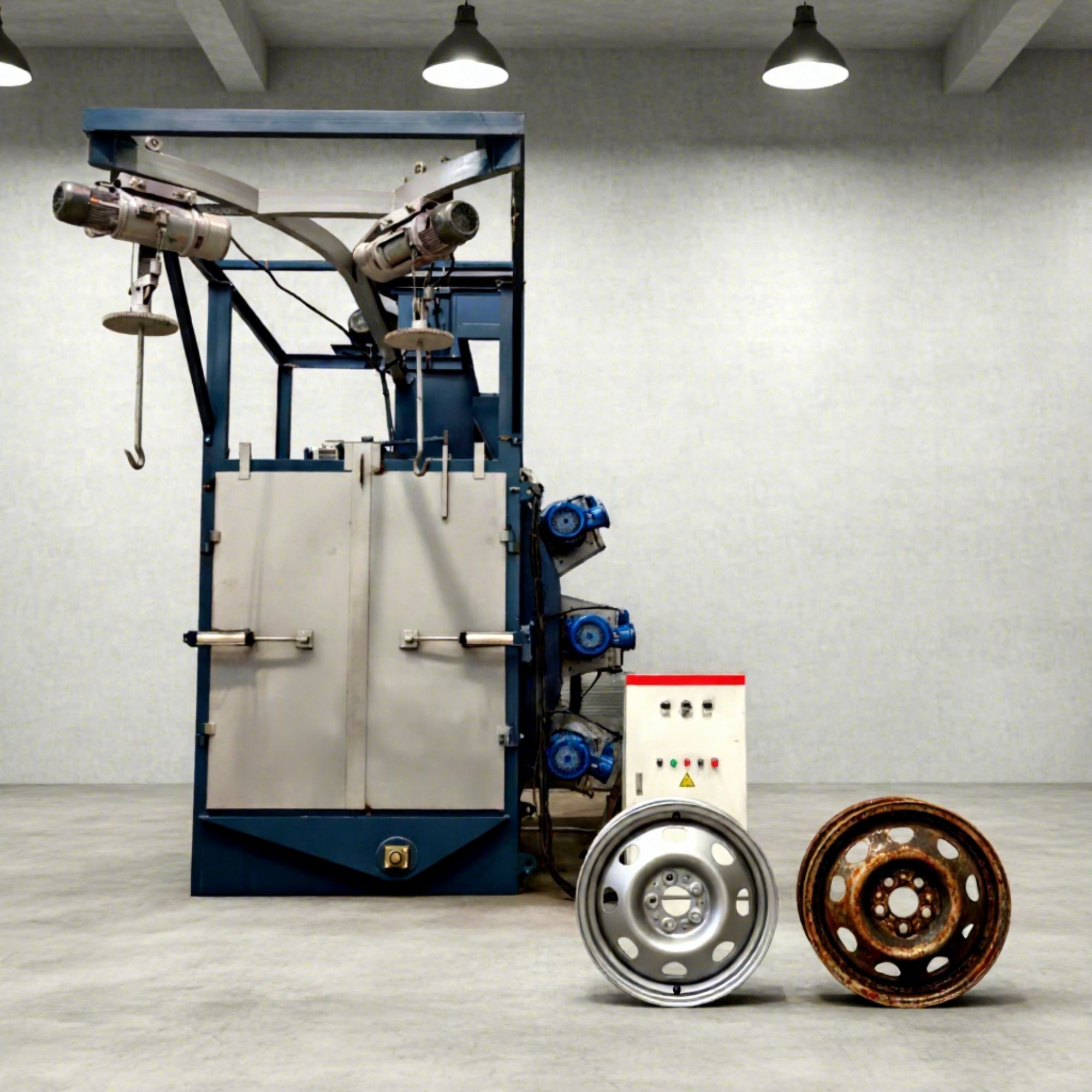
Traditional hook machines often suffer from delays caused by manual threading and slow pattern changes. Our system integrates a rapid-thread mechanism that reduces setup downtime by nearly half. Instead of workers spending up to an hour rethreading for a new design, the automated feed system swaps yarn carriers in under two minutes, keeping production flowing without the usual bottlenecks.
Another overlooked aspect is real-time tension adjustment. Most machines require halting the line to tweak individual hook tensions, but ours uses smart sensors that continuously monitor and self-correct on the fly. This eliminates stops for quality checks and trims wasted material, directly shaving hours off every bulk order. The result is a seamless run from first stitch to final inspection, with fewer interruptions and consistent output that meets tight deadlines.
We also redesigned the hook assembly itself for easier maintenance. Instead of waiting for a technician to dismantle sections for cleaning or replacement, operators can pop out single hooks and swap them in seconds. Combined with predictive wear alerts, the machines avoid unexpected breakdowns that derail schedules. It’s this combination of small, practical improvements that collectively push turnaround times well below industry norms, giving our clients a reliable edge without compromising on stitch precision.
Key Design Features That Reduce Maintenance Needs
Thoughtful engineering can dramatically cut down the time and money spent on upkeep. By prioritizing modular components, designers allow quick replacement of worn parts without dismantling entire systems. Sealed bearings, corrosion-resistant coatings, and self-lubricating materials further minimize routine servicing, while smart sensor integration alerts operators before minor issues escalate.
Another often-overlooked strategy is simplifying access to critical areas. Hinged panels, tool-less fasteners, and logically organized internal layouts make inspections and repairs straightforward, reducing both downtime and the likelihood of errors during maintenance. When combined with clear, durable labeling and intuitive error codes, even less-experienced staff can confidently perform basic troubleshooting.
Finally, the selection of robust, standardized parts can’t be overstated. Using common off-the-shelf components instead of custom-engineered pieces means replacements are cheaper and globally available. Additionally, designing with generous tolerances for dirt, heat, and moisture ensures the equipment remains reliable in real-world conditions, not just in a clean testing environment.
Surface Finishing Consistency Across Various Part Geometries
Achieving uniform surface finishes on parts with complex shapes or sharp transitions can be tricky. The challenge usually comes down to how the finishing tool or medium interacts with corners, recesses, and irregular contours. Even a well‑tuned process can leave subtle variations if the path strategy or dwell time isn't adapted to the local geometry. Flat areas might end up slightly smoother than deep pockets simply because of accessibility and abrasion patterns.
One practical way to improve consistency is to map out the part in terms of critical zones and then tailor the finishing parameters for each. For instance, a cylindrical surface might benefit from a continuous, helical toolpath with consistent overlap, while a compound curve might need a multi‑axis approach to keep the contact area steady. Small fillets and tight radii often demand reduced step‑overs or softer backing pads to avoid over‑cutting the edges. The goal isn't just matching Ra values across the whole part, but making sure the visual and tactile appearance feels seamless.
Material choice and pre‑finishing steps also play a big role. A part that's been evenly stress‑relieved and uniformly machined before finishing is far easier to handle. Sometimes a slight adjustment to the media—switching to a more compliant abrasive or altering the grit progression—can smooth out the disparities caused by geometry changes. In the end, consistency comes from treating the finishing process as something that must adapt to the part's unique shape rather than expecting a single recipe to work everywhere.
Real-World Results: From Rust Removal to Paint Prep
Watching years of oxidation vanish in minutes feels almost like a magic trick. A neglected iron gate, left to the elements until its surface turned a flaky mess, came back to life after a single session with a fiber laser cleaner. The beam swept over the metal, eating away rust but leaving the solid base untouched. No harsh chemicals, no endless grinding—just a quiet hum and the satisfying reveal of clean steel. That moment, when the grime peels back to show what’s underneath, never gets old.
On a different job, an automotive shop needed a classic car hood stripped for repainting—fast. Traditional sanding would’ve taken hours and risked warping the thin panel. The laser handled it in a fraction of the time, removing multiple paint layers down to the bare metal without generating heat that distorts. The surface came out lightly etched, perfectly ready for primer to bond. The owner joked he’d wasted decades on dust and noise.
Even in less extreme cases, like cleaning up weld seams on stainless steel, the difference shows immediately. The laser erases heat tint and surface oxides, leaving a clean, passivated finish that matches the surrounding material. It’s the kind of precise, real-world performance that shifts skepticism into outright enthusiasm; once you see it work, you start mentally lining up every project in reach.
Integrating Shot Blasting into Your Production Line Efficiently
Bringing shot blasting into an existing workflow often feels like fitting a square peg into a round hole – until you learn to look at your line as a single, living system rather than a collection of independent machines. True efficiency begins weeks before the equipment arrives, with a thorough audit of part flow, bottleneck points, and material handling intervals. Too many shops treat the blaster as an island, loading and unloading by hand, which kills any hope of a tight cycle time. Instead, map out exactly where cleaning fits in the manufacturing sequence: before coating, after welding, or between machining steps. Consider the real estate around the machine, the path parts take from the previous station, and how they exit. Sometimes the smartest move is to shift a conveyor a few degrees or add a simple roller bed to eliminate the need for a dedicated operator. That kind of pre-planning turns integration from a headache into a seamless extension of what you already do.
The physical connection is only half the story – the other half is deciding how media flows and gets replenished without slowing things down. A common mistake is under-sizing the separator or dust collection, which leads to abrasive contamination, inconsistent surface profiles, and constant maintenance interruptions. Size your air handling to pull fines at the rate your production demands, not just the blaster’s catalog spec. Also, look at how you’ll introduce fresh abrasive: an automatic top-up system paired with a large-capacity hopper might cost more upfront but pays back quickly when you’re not pausing shifts to refill. And don’t forget about part orientation. Sometimes a simple fixture change lets you hit critical surfaces in a single pass, eliminating the need for re-blasting or manual touch-up downstream. These details are where integration moves from ‘functional’ to ‘effortless’.”
Finally, the human side often gets overlooked, but it’s the glue that holds everything together. Operators who understand the blaster’s rhythm can tweak nozzle angles, adjust media mix, and spot wear patterns before they become downtime, but only if they’re given the right training and autonomy. Set up measurable checkpoints – visual finish standards, hourly dust emission checks, amperage draw on the wheel motors – and empower the team to act when readings drift. Build short feedback loops between the blasting station and the next process: if paint adhesion drops, you know within minutes, not days. Over time, that awareness turns integration into optimization, where the production line almost self-corrects and you spend less time firefighting and more time pushing output. That’s the real goal: a line where shot blasting isn’t a necessary evil but a natural, low-effort step that boosts everything downstream.”
FAQ
A custom hook type shot blasting machine is tailored to specific workpiece geometries and production requirements, unlike off-the-shelf units. It suspends parts on rotating hooks that travel through a blast chamber, allowing for thorough coverage of complex shapes. Customization can include hook capacity, blast wheel placement, dust collection systems, and material handling integration, which standard machines rarely offer without significant retrofitting.
This equipment excels with large, heavy, or irregularly shaped components that can be hung, such as weldments, castings, forgings, engine blocks, structural steel beams, and fabrications. It's ideal when tumbling or table blasting would cause damage or inadequate coverage due to part geometry. The suspended position ensures all surfaces are exposed to the blast stream without part-on-part contact.
With precise engineering, it can handle delicate tasks. By adjusting blast media type, size, velocity, and exposure time, operators can achieve gentle cleaning or cosmetic finishing on softer metals, aluminum, or even certain plastics. Custom solutions often include variable frequency drives on blast wheels and adjustable swing speeds to fine-tune the process for fragile components.
Customization optimizes every aspect for a particular product line. For instance, multiple blast wheels can be strategically positioned to target shadow areas, reducing the need for manual rework. Custom hooks or fixtures can hold parts at ideal angles, and automated loading/unloading can slash cycle times. Tailored dust extraction systems keep the media clean, ensuring repeatable finish quality across batches.
A good system uses a two-stage recovery: a scalping screen removes large debris, then a magnetic or air wash separator extracts fine contaminants before recirculating clean media. High-efficiency cartridge dust collectors with pulse-jet cleaning are standard. For custom setups, you might add an abrasive flow monitoring system and automatic media replenishment to maintain optimal blasting conditions without operator intervention.
Modifying a standard machine often leads to compromises in workflow, safety, and efficiency. A ground-up custom build ensures the blast chamber dimensions, hook capacity, and conveyorized loading are perfectly matched to the production volume and part size. It reduces long-term operating costs through better energy efficiency and lower maintenance, and it integrates seamlessly with upstream and downstream processes, minimizing handling.
It starts with understanding the substrate and desired finish—steel grit for aggressive descaling, glass bead for satin finishes, or ceramic for tough coatings. Sample testing is crucial. The number and horsepower of blast wheels depend on required coverage rate and part complexity. Computer simulation can model blast pattern overlap to ensure no dead spots, especially on parts with deep recesses or complex contours.
Beyond routine checks, the hook assembly needs regular inspection for wear and balance, as it's constantly under load and rotation. Custom designs can incorporate quick-change wear plates in high-impact zones, automated lubrication systems, and abrasive sensors that alert when media is spent. Some builders offer modular wear components that can be swapped out in minutes rather than hours, significantly boosting uptime.
Conclusion
Custom hook type shot blasting machines redefine surface preparation by adapting precisely to the workload rather than forcing a one-size-fits-all approach. The suspension design, combined with adjustable blast patterns and variable speed controls, means even oddly shaped parts get full coverage without manual repositioning. This tailored architecture directly shortens cycle times—parts move through the system faster because the abrasive stream hits exactly where it’s needed, eliminating wasteful over-blasting. At the same time, the engineering choices that speed up processing also cut downtime: heavy-duty wear plates, easily accessible blast wheels, and self-cleaning abrasive recycling loops keep the machine running with minimal intervention. Maintenance tasks that typically halt production are simplified, so operators spend less time troubleshooting and more time meeting throughput targets.
Surface finish consistency holds across diverse part geometries—whether it’s delicate aluminum castings or rugged steel fabrications—because the hook rotation and multiple blast nozzle angles ensure uniform exposure. In real-world use, these systems effortlessly shift from aggressive rust and scale removal to the gentle profiling needed for paint adhesion, all without swapping equipment. Integrating such a machine into an existing line is equally straightforward: compact footprints, modular conveyors, and plug-and-play controls let it slot into current workflows without extensive reengineering. The result is a seamless extension of production capacity, where shot blasting becomes a reliable, low-fuss stage that feeds directly into coating or assembly operations.
Contact Us
Contact Person: Bruce
Email: [email protected]
Tel/WhatsApp: +86 15166629468
Website: https://www.povalchina.com/