
China Sunscreen Spray Supplier: Your Guide to Reliable Manufacturing and White Label Options
2026-08-15
When sourcing sunscreen sprays from China, 'reliable' and 'customizable' rarely appear in the same sentence. That’s exactly where Wilson changes the conversation. With years of manufacturing expertise and a white label program built for real brands, Wilson offers a path to market that doesn’t sacrifice quality for speed. Curious how? Let’s dive into the essentials.
What Actually Separates a Reliable SPF Spray Manufacturer in China
Plenty of factories can fill a can, but very few can hold a formulation stable through sixteen hours of humidity, a third-party audit, and a sudden spike in demand. The real divide shows up in the details: how they document batch traceability, whether their propellant and valve suppliers are name-brand or no-name, and if the lab actually does forced degradation testing instead of just measuring SPF once. A manufacturer that invites you to watch a fill line run your exact product, not a demo batch, is already ahead of most.
Beyond the equipment, listen to how they talk about failure. A dependable partner will tell you which preservatives failed their challenge tests, which aerosol valve clogged at 45°C, and how they fixed it before you ever saw a sample. They will ask about your target market's regulatory quirks—EU nanoparticle labeling, US OTC sunscreen monograph, Australia's stricter UVA ratio—without you prompting. That kind of proactive knowledge means their QC team sees more than a spreadsheet; they see the product on a shelf in Manila or Berlin.
Finally, watch their raw material pipeline. Sunscreen actives like avobenzone and octocrylene fluctuate in purity and price, and a reliable maker holds safety stock, tests each lot for photostability, and can explain why they chose one TiO2 grade over another for sprayability. If they shrug and say "standard grade," walk away. The ones worth your order are the ones who can tell you the particle size distribution, the valve spray pattern at 25°C and 40°C, and the exact can pressure drop over 12 months—all before you sign a contract.
White Label Sunscreen Sprays: Customization Beyond Your Logo
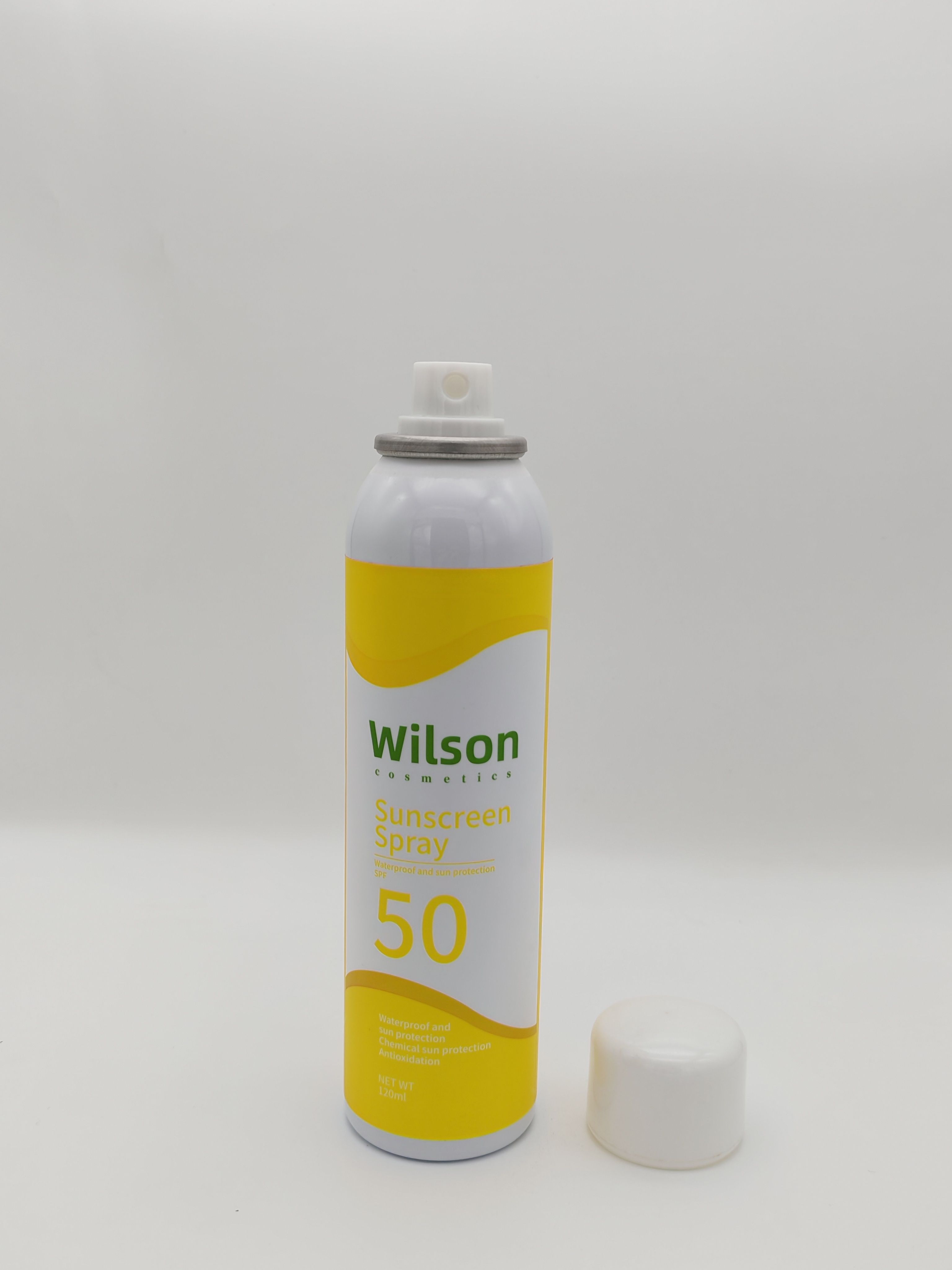
White label sunscreen sprays give you more than a spot to stamp your name. The real opportunity lies in tailoring the formula itself—selecting the UV filter system, adjusting the finish from dewy to matte, and choosing whether the spray feels weightless or slightly hydrating. This level of control lets you craft a product that matches your brand's skin philosophy, not just its visual identity.
Beyond the liquid inside, you can shape the entire user experience. Pick a continuous spray mechanism for even coverage or a bag-on-valve system for a cooler, finer mist. Decide on the bottle's silhouette, cap color, and label texture so the product feels like yours when someone holds it. These tactile details often matter more than a logo in building repeat customers.
Smart customization also includes practical choices like fragrance intensity, added antioxidants, or reef-safe claims that align with your audience's values. By thinking past the logo, you turn a generic sunscreen into a signature product—one that stands out on crowded shelves and earns a permanent spot in beach bags.
Navigating SPF Testing and Certification Without the Headaches
SPF testing often feels like a maze of contradictory regional standards, where a product passing one market's criteria can fail another's by a wide margin. The real headache isn't the science itself—it's the patchwork of protocols, from ISO 24444 to FDA monographs, each with subtle differences in application density, water resistance claims, and even the definition of 'broad spectrum.' Manufacturers waste months chasing certification only to discover their chosen lab used an outdated reference sunscreen or failed to account for photostability under real-use conditions. The key is to map your target markets before a single sample is submitted, then select a laboratory that not only holds the right accreditations but also has a track record of defending results during regulatory review.
A smarter approach starts with treating SPF testing as a design input rather than a final hurdle. Too many brands formulate to a theoretical SPF 30 based on raw ingredient data, then panic when in vivo results come back at 18 or 45—both equally problematic for label claims. The fix is to run pre-screening assays on multiple prototype variants, using the same substrate and application method that the final certification will demand. This catches formulation drift early, whether it's caused by emulsifier interactions, film-forming polymers that reduce uniformity, or the way certain organic filters degrade under UV exposure before they ever reach a panelist's back.
Finally, don't underestimate the human factor in certification timelines. A lab's queue can stretch months during peak season, and retesting after a failed batch burns both budget and launch windows. Build in buffer time by submitting parallel samples to two accredited facilities for critical claims, then reconcile discrepancies before they become regulatory roadblocks. Document every variable—temperature during storage, panelist skin type distribution, even the batch number of the reference standard—because auditors will ask. When you treat the process as a controlled experiment rather than a bureaucratic box to tick, the headaches largely disappear, leaving only the quiet confidence of a claim that holds up under scrutiny.
How to Vet a Chinese Factory for Aerosol Sunscreen Production
When vetting a Chinese factory for aerosol sunscreen production, start by confirming that the facility holds a cosmetic production license from the local NMPA branch and can legally manufacture pressurized aerosols. Sunscreen aerosols are not simple liquids; the propellant mix, can lining, and valve system must all be compatible with UV filters like avobenzone and octocrylene. Ask for batch records from any recent aerosol runs, not just samples, and check whether they have a separate explosion-proof filling zone with gas detection and proper ventilation. A general cosmetics line cannot safely handle butane or propane blends.
On-site, watch the actual filling process rather than relying on a polished conference room presentation. Inspect how they purge air from cans before crimping, how they test for leakage after filling, and whether they keep retained cans from each lot for stability tracking. Request accelerated stability data for your specific formula in their exact can and valve combination, because a passing test with one actuator or propellant ratio means little. Finally, ask about their export history for aerosol sunscreens to markets with similar regulatory demands, and verify those references independently through shipping records or direct calls to past clients.
MOQs, Pricing, and Lead Times: Real Numbers to Plan Around
Most off-the-shelf models start at a 300-unit minimum, which keeps per-piece costs predictable without forcing you into overstock. At 300 units, pricing sits around $4.10 per unit, but jump to 1,000 units and that drops to $3.25. For custom colorways or private-label tweaks, the MOQ climbs to 1,200 units, and expect to add a one-time setup fee of $180 per design — this covers plate changes and sample approvals.
Standard production runs ship in 18–22 days after artwork approval. If you need a pre-production sample before the full batch, budget an extra 5–7 days. Peak season (September through November) stretches lead times to 30–35 days because raw material suppliers run at capacity. Rush orders are possible at a 15% surcharge, trimming the wait to 10–12 days, but only for repeat designs with no changes to the bill of materials.
Formulation Trends in Spray Sunscreen That Buyers Often Miss
Most buyers fixate on SPF numbers and forget that the real story in spray sunscreens lies in the propellant system. A shift toward nitrogen-based and bag-on-valve technologies is quietly replacing traditional hydrocarbon aerosols, reducing both skin irritation and environmental residue. These systems also allow for finer, more even misting without the chilling effect that causes users to under-apply.
Another overlooked area is the incorporation of film-forming polymers that improve water resistance without sticky buildup. Spray formulas are now using acrylate copolymers and silicone derivatives that create a flexible, breathable shield, extending protection during sweat and swimming. Buyers rarely check for these ingredients, yet they dictate whether a sunscreen stays on during real outdoor activity.
Finally, formulators are adding low-level antioxidants like vitamin E and ferulic acid directly into spray bases. This isn't just marketing—these additives stabilize avobenzone and other UV filters against degradation, which maintains SPF integrity under sunlight. A sunscreen that looks identical on the label can perform vastly differently depending on these hidden stabilization strategies.
FAQ
Look beyond glossy brochures. Ask for the batch records of their last three sunscreen spray runs, not just samples. Verify they have in-house stability chambers and can show real-time data on spray valve clogging after 90 days. Also check if their filling line handles bag-on-valve or standard aluminum cans, because that changes your formulation options significantly.
You typically start with a base formula the factory already has, then adjust fragrance, color, and packaging to match your brand. Some suppliers let you tweak active ingredient percentages within approved limits, but full custom formulation costs more and takes longer. Make sure they give you a written formula ownership clause before you pay for any development work.
GMP for cosmetics is the minimum, but for sunscreen you also want ISO 22716 and ideally a recent audit report from a third party like SGS or Intertek. If you plan to sell in the EU or Australia, ask for product-specific test reports showing compliance with those regions' UV filter limits—not just a generic certificate on the wall.
Yes, but treat them as separate projects. Packaging customization is relatively quick: choose your can size, actuator, cap color, and label design, and the factory can often source the components within two to three weeks. Formula customization requires reformulation, stability testing, and sometimes new SPF testing, which can add three to six months before production starts.
Most established Chinese suppliers start around 5,000 to 10,000 units per SKU for standard packaging. If you want fully custom tooling for a unique actuator or can shape, expect the MOQ to jump to 20,000 or more because the component factory also has its own minimums. Always ask if the MOQ is per formula, per fragrance, or per packaging variant—this is where budgets often break.
Don't rely only on the supplier's word. Request a copy of the SPF and UVA test reports from an ISO-accredited lab, and check the batch number on the report matches the sample they sent you. Also, test the spray pattern and droplet size yourself—if the mist is too fine, users inhale more product, which is a safety issue many brands overlook.
The biggest one is assuming all quotes include the same thing. One supplier might quote only bulk filling, while another includes caps, actuators, labels, and cartons. Another pitfall is ignoring propellant compatibility: some fragrances or emollients can degrade the valve over time, leading to leaking cans three months after shipment. Always ask for a valve compatibility test report.
For a stock formula with standard packaging, plan on 45 to 60 days: component sourcing takes about two weeks, filling and labeling another week, and then you need at least 30 days for stability checks before shipping. If you're customizing the formula, add another 60 to 90 days for reformulation and SPF testing. Rush orders are possible, but they almost always mean skipping the stability hold, which is a risk you shouldn't take.
Conclusion
Finding a Chinese sunscreen spray supplier that actually delivers on aerosol stability and SPF consistency means looking beyond polished trade show booths. The real separation often comes down to in-house filling lines, controlled propellant ratios, and batch-level testing records rather than just a competitive quote. White label work has moved far past slapping a logo on a generic can—buyers now expect custom nozzle geometry, skin-feel tweaks, and even fragrance-free variants that still pass post-filtration SPF verification. Factories worth shortlisting will walk you through their ISO 22716 documentation and China NMPA sunscreen filing history without hesitation, while weaker partners tend to deflect toward marketing claims.
On the commercial side, realistic MOQs for aerosol sunscreens in China typically land between 5,000 and 20,000 units per SKU, with lead times stretching anywhere from 35 to 60 days once packaging is locked. Pricing depends heavily on propellant type and whether you request bag-on-valve technology, which can add thirty to fifty cents per unit but dramatically improves spray uniformity. Formulation gaps that often get missed include reef-safe booster systems, quick-break emulsions for lower alcohol feel, and hybrid UV filters that hold up better under high-heat filling. Ask for thermal stability data at 45°C and eight-week viscosity checks—not just a sample that feels good on day one. A supplier that treats those details as standard is usually the one that will keep your reorders clean and your compliance file thin.
Contact Us
Contact Person: Simon
Email: [email protected]
Tel/WhatsApp: +86 13267966849
Website: https://www.wilsoncosmetic.com