
Bogie Hearth Furnace: A Few Recommended Models for Industrial Use
2026-11-02
Most industrial furnaces promise even heating. Few deliver it when the load weighs 50 tons and the door swings open. That’s exactly where a bogie hearth furnace earns its keep. Below, we look at a handful of models that solve real shop-floor problems—from heavy fabrication to batch annealing—and explain why THINKING-LONG trusts these designs for demanding applications. Let’s get into the details.
Why a Bogie Hearth Handles Heavy Loads Without Wasting Floor Space
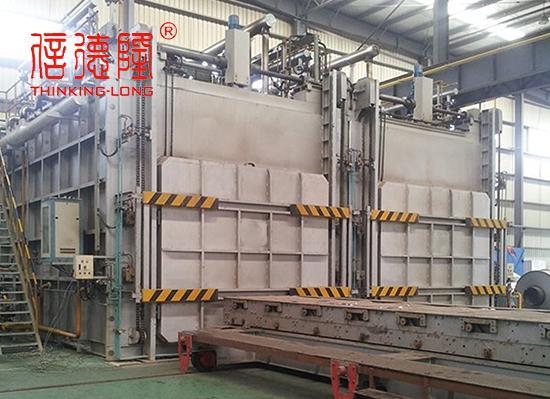
A bogie hearth furnace moves the entire floor of the heating chamber out to the loading area. Instead of trying to maneuver a heavy workpiece through a narrow door and into a hot chamber, operators place the load onto the hearth while it sits in the open. Overhead cranes or fork trucks can approach from multiple sides, set the load down exactly where needed, and then the whole assembly rolls back into the furnace on rails. This eliminates the need for internal access aisles, turning radii, or clearance gaps that would otherwise eat up square footage.
Because the load is supported directly by the moving hearth, the furnace interior does not require additional structural supports or walkways. The weight gets distributed across a large flat surface, reducing point loads and allowing the furnace shell to be installed closer to walls or neighboring equipment. Facility planners can place the bogie furnace in a straight line with other processing stations, using the same rail path for both loading and unloading. That linear flow keeps the footprint compact without compromising the ability to handle massive components.
Another space-saving aspect is that the external loading position can double as a staging area. While one batch is heating, the next load can be prepared on a spare bogie or the same bogie after it exits on the opposite end. There is no need for a dedicated loading dock inside the plant because the hearth brings the furnace floor to the load, not the other way around. This practical arrangement is why bogie hearths are common in steel mills, forge shops, and heat treatment plants that regularly process large castings, coils, or fabrications.
Getting Consistent Temperatures Across Wide Chambers
Wide chambers create unique thermal dynamics. Heat tends to rise, and with greater horizontal span, the center can lag behind edges or vice versa. In many designs, simple single-point control leaves cold corners and hot spots because air circulation patterns aren't uniform. Achieving consistency demands attention to how air enters, moves, and exits.
One effective approach is to divide heating into independently controlled zones, each with its own sensor and output. This lets the system compensate for edge losses without overheating the core. Adjustable baffles or perforated ducts can shape airflow, steering warm air to areas that typically run cooler. Some setups also use pulse-width modulation to fine-tune element output rather than relying on coarse on/off cycles.
Verification matters as much as hardware. Mapping temperatures across multiple points under loaded and empty conditions reveals drift that a single probe misses. Over time, data from these mappings can inform setpoint offsets for each zone, making the chamber behave as if it were much smaller. The goal is a stable thermal envelope that avoids constant hunting.
Burner Configurations That Keep Fuel Costs From Getting Out of Hand
Most fuel waste in burner operation comes down to excess air. A burner set up with a fixed damper often pulls in far more combustion air than needed at lower firing rates, which cools the flame and sends unburned fuel up the stack. Switching to a linkage-less setup with independent fuel and air actuators lets you trim the oxygen level at each firing point without the mechanical slop of cams and rods. On many boilers, dropping excess oxygen from 6% down to 2.5% can cut fuel use by 1–2%—not dramatic on paper, but it adds up quickly across a heating season.
Turndown matters just as much as trim. A burner that cycles on and off ten times an hour because it can't hold a stable low fire wastes fuel on every purge and pre-purge cycle. Configurations with a true 10:1 or even 15:1 turndown, paired with a variable-speed drive on the combustion air fan, keep the burner running longer at a lower, more efficient rate. Add flue gas recirculation if NOx limits force you into leaner mixtures—recirculated flue gas lowers flame temperature without the same efficiency penalty as opening the air damper wide.
The Jobs These Furnaces Take On, From Annealing to Ceramic Firing
Walk into a well-equipped heat-treat shop and you might catch the same furnace softening a batch of copper wire one week, then running a completely different cycle for alumina ceramics the next. Annealing is one of the most common tasks: heating metal to a specific temperature, holding it there long enough to relieve internal stress, and then cooling it slowly so the grain structure relaxes without cracking. The trick is in the details—uneven airflow or a few degrees of drift can leave you with wire that conducts differently from one end to the other, so the furnace has to deliver a consistent thermal profile across the entire load.
Ceramic firing pushes the equipment much harder. Green ceramic parts need a slow, controlled ramp through the low-temperature range where residual moisture and organic binders burn off; rush this stage and you will see cracks before the kiln even reaches its peak. Then comes the real heat: porcelain settles around 1200–1300°C, while technical ceramics like alumina or zirconia often demand 1600°C or more. At those temperatures the heating elements, insulation, and even the furnace shell are under constant stress. A good furnace holds a tight plateau for hours without cold spots, because a temperature gradient of just a few degrees across a large ceramic plate can warp it beyond use.
Beyond annealing and ceramic work, these furnaces handle a rotating list of jobs that would surprise anyone who thinks of a furnace as a one-trick machine. Case hardening processes like carburizing and nitriding inject carbon or nitrogen into the surface of steel parts, while brazing joins dissimilar metals using a filler that melts just above the base metal's solidus. Powder metal sintering fuses compacted particles into dense components, and glass annealing slowly cools newly formed sheets so they do not shatter from residual stress. Modern units store multiple recipes—each with its own ramp rates, soak times, and atmosphere settings—so an operator can switch from a hydrogen-rich brazing cycle to an inert argon purge for titanium with little more than a button press.
What to Check on the Hearth Car Before It Causes Downtime
The hearth car is one of those pieces of equipment that rarely gets attention until it stops moving. A quick walk around before each shift saves hours of unplanned repair. Start by listening to the wheel bearings while the car is rolled a short distance by hand. A dry, grinding sound means lubrication has failed or contamination has worked its way inside. If you feel any roughness through the frame, stop and inspect immediately rather than hoping it will smooth out under load.
Look closely at the refractory lining, especially around door openings and the joints between sections. Small cracks here widen fast once heat cycles begin, and loose brick will eventually drop onto the track or jam the drive mechanism. Press your palm flat against the sidewall in a few spots. If one area is noticeably hotter than the surrounding surface, that points to a thin spot or an air gap behind the lining that will only grow worse.
Finally, check the drive chain or rack-and-pinion for uneven wear and proper tension. A loose chain skips teeth and throws off positioning, which leads to misaligned loads and repeated emergency stops. Wipe a rag along the rails and look for metal shavings or dust that indicates sprocket misalignment. Ten minutes spent checking these details before the car is scheduled into production almost always beats a mid-run failure that stalls the entire line.
When a Rebuilt Unit Makes More Sense Than a New One
A rebuilt unit often wins on cost when the equipment around it has already passed the midpoint of its service life. Installing a brand new assembly into a machine with high hours or heavy wear rarely returns the investment at resale or in extended downtime. A careful rebuild that replaces only the worn internals while reusing the original housing and core can deliver nearly the same lifespan for a fraction of the price.
Availability also tips the balance. New units for older models are frequently out of production or stuck on backorder for weeks, while a local rebuilder can turn a core around in days. That shorter wait matters when a vehicle or production line is offline. Rebuilt units can also preserve the original calibration and mounting footprint, which avoids the small fitting headaches that new replacement parts sometimes introduce.
There is a practical side too. Sending a core back for rebuilding keeps a bulky metal assembly out of the scrap pile and reduces the demand for new raw materials. Many reputable rebuilders now include a warranty that matches or comes close to new part coverage, so the old assumption that rebuilt means risky no longer holds across the board. The decision comes down to matching the part to the expected remaining life of the equipment, not automatically paying for new.
FAQ
The BH-2400 stands out for large steel castings. It offers a 40-ton load capacity, a chamber length of 8 meters, and can run up to 1100°C. The powered bogie moves on floor-level rails, which makes loading heavy castings much simpler without an overhead crane.
The smaller BH-1200 and mid-size BH-2400 both work well for forging preheating, typically between 850°C and 1000°C. The BH-1200 handles up to 12 tons and reaches 1000°C, which suits most open-die and closed-die forging shops.
The BH-3600 is rated for 60 tons and can operate at up to 1200°C. It's often chosen for stress relieving large welded fabrications or normalizing heavy forgings where extra chamber height and width are needed.
Yes, the BH-800 is a smaller unit with an 8-ton capacity and a maximum temperature of 950°C. It's a practical choice for tool rooms and small batch hardening because it doesn't require a deep foundation and can be installed on an existing shop floor.
Most of them use lightweight ceramic fiber linings instead of firebrick. That reduces heat storage and lets the furnace reach temperature faster. The bogie seals tightly against the furnace body, and some models have regenerative burners to recover waste heat from the exhaust.
They typically use multiple thermocouples placed along the chamber length and a PLC-based controller that adjusts burner firing zones independently. This keeps the temperature spread within ±5°C, which is important for avoiding hot spots in large loads.
For ceramic firing, the BH-5000 model can be configured for temperatures up to 1300°C with electric heating elements. It has an 80-ton capacity and a wide hearth, which is useful for firing large refractory shapes or technical ceramics in a single batch.
The bogie can be rolled out completely for inspection and repairs, so you don't have to work inside a hot chamber. Worn hearth seals and wheels can be replaced without dismantling the roof or walls, which cuts downtime during routine servicing.
Conclusion
Bogie hearth furnaces earn their place in heavy industrial settings by carrying substantial loads without eating up floor space. The car-bottom design lets you load outside the furnace, then roll the entire hearth into the chamber, so you avoid awkward crane work and keep the shop floor clear. Wide chambers still hold even temperatures when the right circulation fans and zone controls are in place, which matters for treating large castings or batches of ceramics. Burner configuration is another point where well-chosen models shine: pulse-firing or high-velocity burners can trim fuel consumption while keeping the temperature profile steady, so operating costs don't spiral as workloads increase.
These furnaces handle a broad range of jobs, from stress relieving and annealing of weldments to firing technical ceramics and glass. Before you commit to a specific model, pay attention to the hearth car itself—check wheels, seals, and drive mechanisms, because a stuck car can shut down production. For many shops, a rebuilt unit with upgraded controls and new refractory makes more financial sense than buying brand new, especially when the shell and car frame are still sound. Choosing a bogie hearth furnace ultimately comes down to matching chamber size, thermal range, and burner type to your typical load, then keeping the car in good shape so downtime stays rare.
Contact Us
Contact Person: Qian Xijun
Email: [email protected]
Tel/WhatsApp: 8613961736750
Website: https://www.thinkinglong.com/